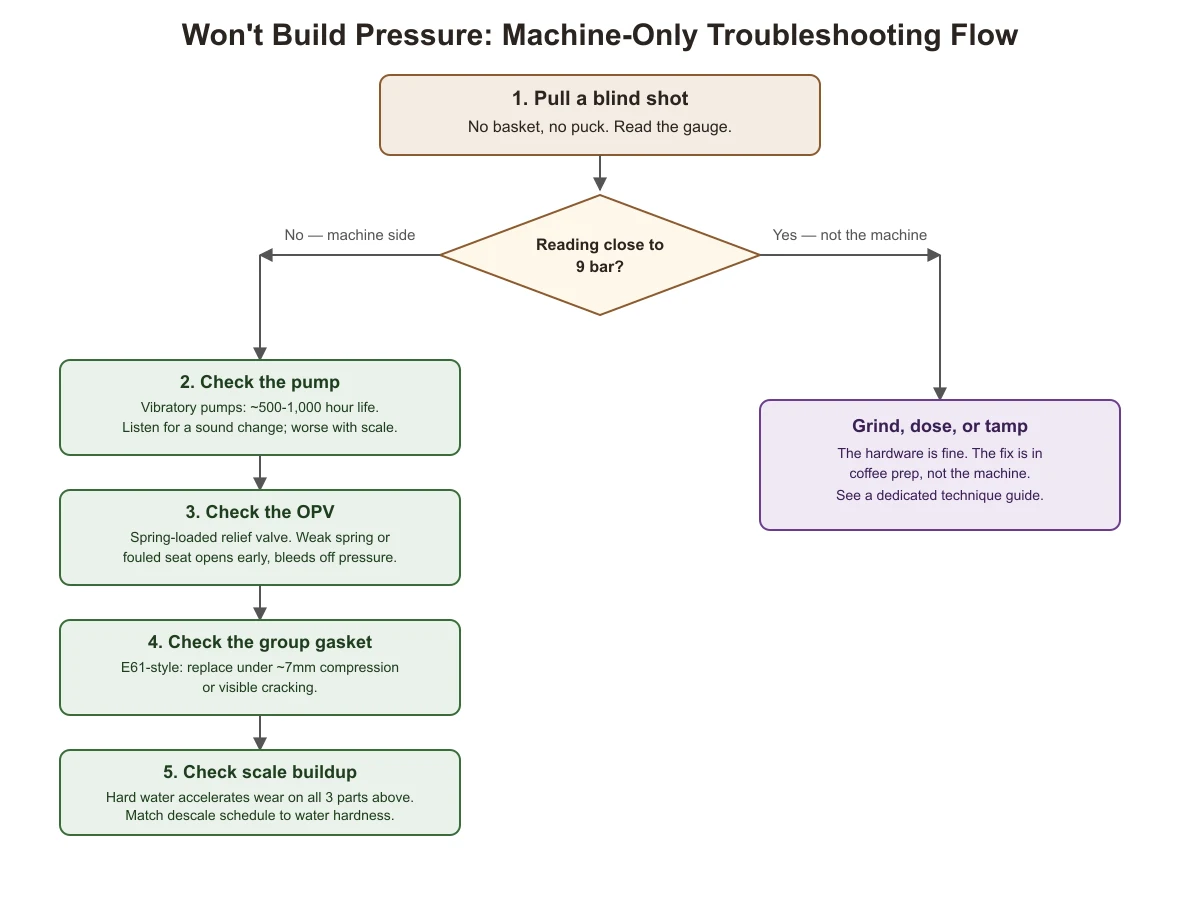
If your espresso machine won’t build pressure, pull a blind shot first — run the machine with no portafilter basket or puck in place and watch the gauge. A reading far below 9 bar points to the machine itself: the pump, the over-pressure valve (OPV), or the group head gasket. If the gauge reads close to 9 bar on that test, the cause is almost always grind, dose, or tamp, not the hardware.
Key takeaways
- A blind-shot test (no basket in the portafilter) separates a machine problem from a grind, dose, or tamp problem in under a minute.
- The OPV is a spring-loaded relief valve. A weakened spring or a fouled valve seat lets it open early and bleed off pressure before it ever reaches the puck.
- Home machines typically run vibratory pumps rated for roughly 500 to 1,000 hours of service life, and they fail faster in hard-water areas where scale builds up internally.
- On E61-style group heads, the gasket is due for replacement once it compresses to below about 7 mm or shows visible cracking.
- If the blind-shot reading is close to 9 bar, stop looking at the machine — the fix is in grind, dose, or tamp technique, which a dedicated technique guide covers in detail.
What does “won’t build pressure” actually mean?
Most home espresso machines are designed to brew at around 9 bar through the puck, and a pressure gauge on the group or boiler shows roughly what the pump and plumbing are producing. “Won’t build pressure” means that gauge reading stays low no matter what you do with the coffee — thin, fast-running shots, little or no crema, and a gauge needle that barely moves. Before touching any tools, it helps to find out whether the shortfall is coming from the coffee puck or from the machine behind it. If you haven’t settled on a machine yet, our home espresso machine buying guide covers what separates the types most likely to need this kind of troubleshooting later.
How do you test whether it’s the machine or your technique?
Pull a blind shot: lock in the portafilter with no basket and no coffee, start the brew cycle, and read the gauge. With nothing restricting flow, a healthy machine should still push close to its rated pressure. If the needle sits well below 9 bar on this test, the problem is upstream of the puck entirely — it’s the pump, the OPV, or the gasket, and no amount of adjusting grind size, dose, or tamp pressure will fix it. If the blind-shot reading looks normal, the machine is doing its job and the issue is almost certainly how the coffee is being prepared.
Could the pump be the problem?
Most home machines use a vibratory pump, and those pumps have a typical service life of roughly 500 to 1,000 hours before they wear out. That wear happens faster in hard-water areas, where scale accumulates inside the pump and its check valves. A failing pump produces lower pressure across the board, on every shot, and it often sounds noticeably different — buzzier, louder, or more strained — than it did when the machine was new. If you’ve never descaled the machine on the schedule your water hardness calls for, scale-related pump wear is worth ruling out before replacing any parts; see our descaling schedule guide for how often that should happen based on your water.
Could the OPV be the problem?
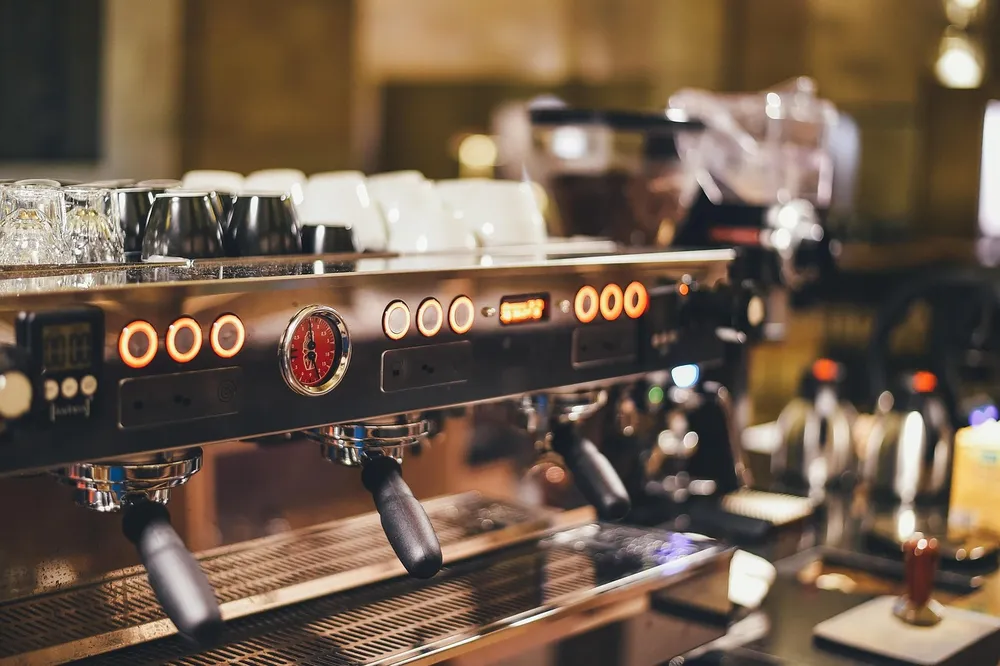
The over-pressure valve (OPV) is a spring-loaded relief valve that limits the pump’s maximum output. When its spring weakens or its seat gets fouled with mineral scale or coffee oils, the valve can open prematurely, bleeding off pressure before it ever reaches the coffee puck. This is one of the most common hidden causes of a machine that “used to work fine” and now runs consistently weak, even with a correct blind-shot setup. An OPV usually needs a technician’s attention to adjust or replace, since it sits inside the pump housing on most consumer machines.
Could the group head gasket be the problem?
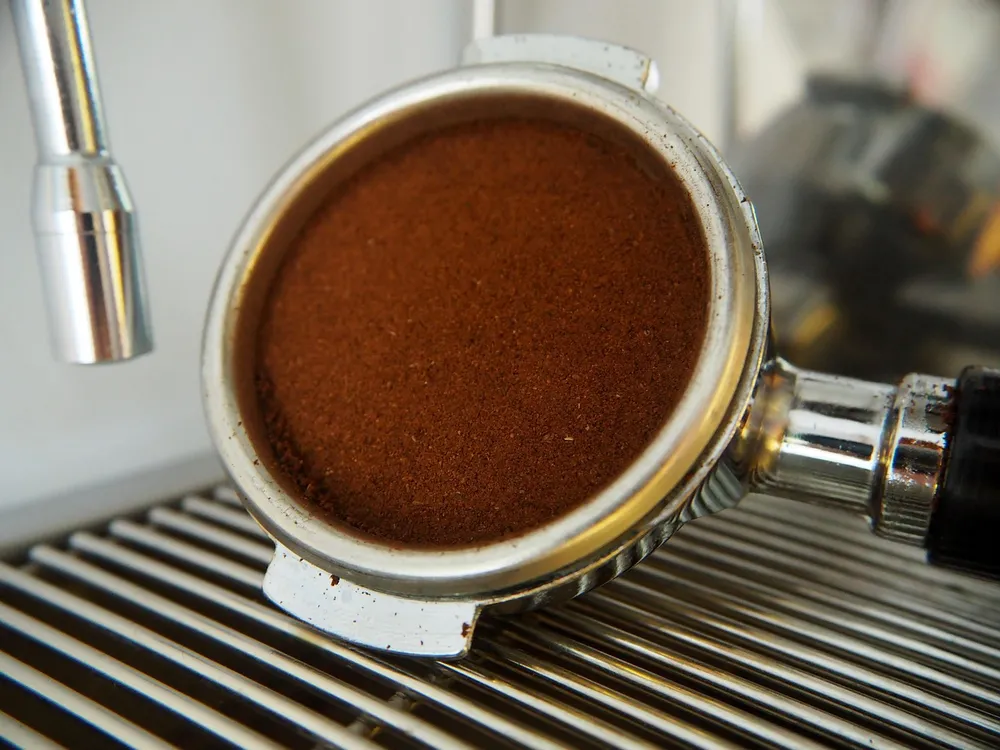
A worn group head gasket lets water escape around the seal of the portafilter instead of being forced through the coffee puck. On E61-style group heads specifically, the gasket should be replaced once it compresses to below roughly 7 mm or shows visible cracking. A failing gasket often shows up as water spitting or dripping around the edge of the portafilter during a shot, in addition to a low gauge reading. This is a lower-cost fix than pump or OPV work and is usually the first thing worth ruling out if the portafilter doesn’t lock in as snugly as it used to.
Does water hardness and scale buildup matter?
Yes. Mineral scale accumulates anywhere water sits or flows under heat and pressure, including inside the pump, the OPV seat, and the boiler. The U.S. Geological Survey classifies water above 180 mg/L (parts per million) as calcium carbonate as “very hard,” and water in that range builds scale noticeably faster than soft water. If your machine is overdue for a descale based on your local water hardness, scale is a reasonable first suspect for weakening pump output or fouling the OPV seat before you assume a part has simply failed. Our descaling schedule guide walks through how to match a descale interval to your water’s hardness.
When is it a grind, dose, or tamp issue instead?
If the blind-shot gauge reading comes back close to 9 bar, the hardware is doing its job, and the pressure problem you’re seeing during normal brewing is downstream of the machine — in the grind size, the dose weight, or how evenly the puck is tamped. That’s a different kind of troubleshooting than anything covered here, and it’s worth working through with a dedicated technique guide rather than replacing machine parts that aren’t actually at fault. And if your symptom is water appearing at the base of the machine rather than weak pressure, that’s a different fault with its own checklist — see our guide to an espresso machine leaking from the bottom.
Machine-side pressure troubleshooting at a glance
| Part | What you’ll notice | Why it causes low pressure | What to check |
|---|---|---|---|
| Pump | Low pressure on every shot; unusual sound | Worn vibratory pump (typical life 500–1,000 hours), often accelerated by scale | Listen for sound changes; check descale history; blind-shot test |
| OPV (over-pressure valve) | Pressure bleeds off before reaching the puck | Weak spring or fouled valve seat opens early | Blind-shot test well below 9 bar with a known-good pump |
| Group head gasket | Water spits or weeps around the portafilter edge | Worn seal lets water escape around the puck instead of through it | Inspect gasket thickness (E61: replace under ~7 mm) and look for cracking |
| Scale buildup | Gradual decline in pressure over months | Mineral deposits restrict pump, valve, and boiler internals | Check water hardness and descale schedule |
Frequently asked questions
Can a dirty portafilter basket cause low pressure?
Yes, though it’s a different mechanism than the pump or OPV. A basket with holes clogged by old coffee oils and fines can restrict flow unevenly, which sometimes reads as weak or uneven pressure. It’s a quick thing to rule out: soak the basket in hot water with a cleaning detergent made for espresso machines and brush out the holes before suspecting a bigger mechanical fault.
How often does the OPV need service?
There’s no fixed manufacturer interval for most home machines; it tends to wear gradually and announce itself as a slow decline in pressure over months or years, especially in hard-water areas. If a blind-shot test shows pressure well below 9 bar and the pump sounds healthy, the OPV is a reasonable next suspect for a technician to check.
Is 9 bar the right number for every machine?
Nine bar is the reference point repair technicians commonly use for a blind-shot check, but your specific machine’s rated pressure can differ. Check your owner’s manual for the manufacturer’s stated figure before assuming any reading is wrong.
Can I test the OPV myself at home?
You can run the blind-shot test yourself with no tools beyond the machine and its pressure gauge. Actually adjusting or replacing the OPV usually means removing the pump housing, which is a job most home users should leave to a qualified appliance technician rather than attempt without the right parts and training.
Should I try to replace the pump myself?
If you’re comfortable with small-appliance repair and can source the correct replacement pump for your model, it’s a doable DIY job on many single-boiler and semi-automatic machines. If you’re not confident working inside the machine’s electrical and plumbing components, a professional repair avoids turning a pump problem into a bigger one.
Sources
- Grindset.cafe: How to Fix Low Pressure on Your Espresso Machine — OPV, pump, and group gasket mechanics
- USGS Water Science School: Hardness of Water — official water hardness classification (mg/L as calcium carbonate)
espressomachinesforhome.com Editorial Team. Last updated: November 13, 2026.