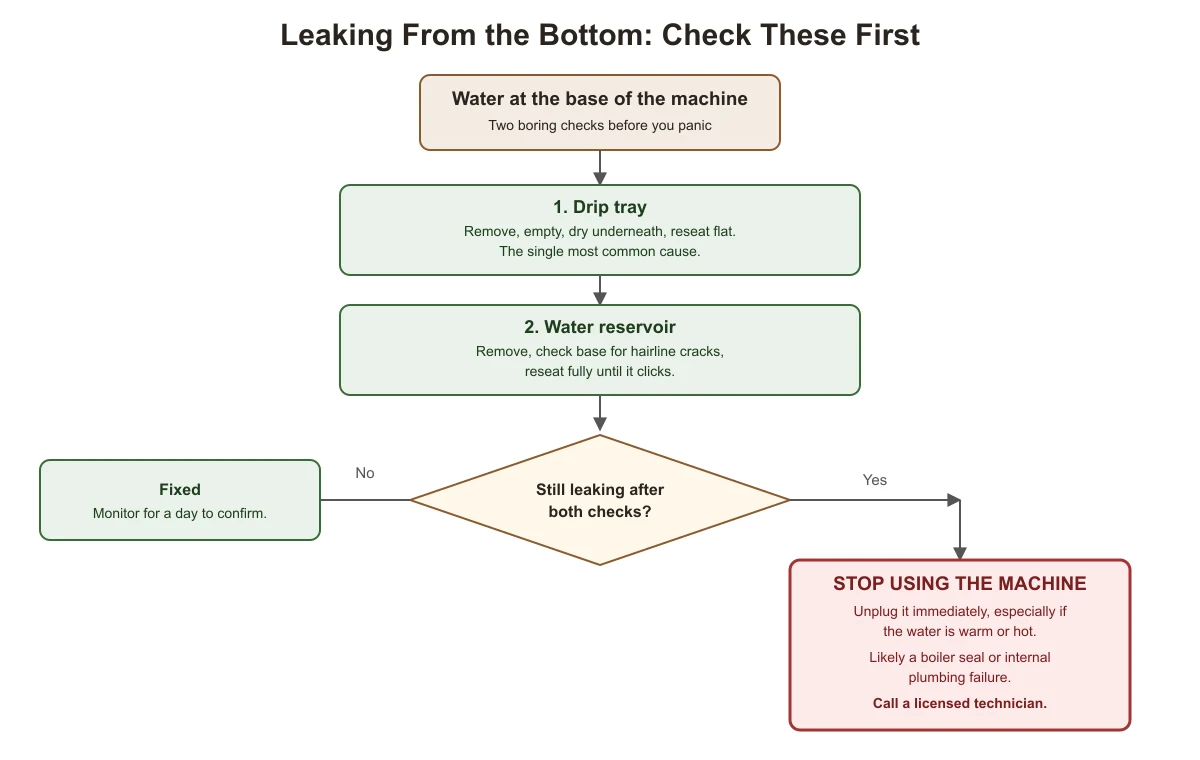
If your espresso machine is leaking water from the bottom, check two boring things first: the drip tray (remove it, empty it, and set it back flat) and the water reservoir (take it out and reseat it fully, checking the base for cracks). If the leak continues after both check out clean, or if the water is warm or hot, stop using the machine and call a licensed appliance technician — that combination points to a boiler or internal seal problem, not a tray or tank issue.

Key takeaways
- An overfull or misaligned drip tray is the single most common cause of water appearing at the base of the machine — rule it out before anything else.
- A water reservoir can look seated but not be fully clicked into place; remove it, reseat it, and inspect the base for hairline cracks.
- If leaking continues after both checks, especially with warm water, it can mean a failed boiler seal or internal plumbing fitting.
- A boiler-related leak is a safety issue: unplug the machine and stop using it until a qualified technician inspects it. Do not open the boiler yourself.
- Hard water accelerates seal and gasket wear throughout the machine, so a leak that keeps coming back is worth checking against your descale schedule.
What usually causes an espresso machine to leak from the bottom?
Before assuming the worst, it helps to know that most bottom leaks trace back to two unglamorous spots: the removable drip tray and the water reservoir. Both sit near the base of the machine, both get removed and replaced constantly during normal use, and both are easy to reseat slightly off without noticing. Internal seal and boiler failures do happen, but they’re less common than a tray that’s simply overfull or a tank that isn’t fully clicked in. If you’re still choosing a machine and want to know which types tend to need the least of this kind of upkeep, our home espresso machine buying guide covers that trade-off.
How do you check the drip tray?
Pull the drip tray all the way out, empty it completely, and dry the area underneath it. Check that the tray sits flat and fully seated when you slide it back in — a tray that’s even slightly tilted or caught on its own rim can let water run over the edge instead of into the tray, which looks exactly like a leak from the machine itself. Run the machine for a normal brew cycle and watch where the water actually appears before concluding the tray is fine.
How do you check the water reservoir?
Remove the reservoir completely, inspect the base and the seal where it connects to the machine for hairline cracks or a buildup of mineral scale, then reseat it firmly until it clicks or sits flush. A reservoir that isn’t fully pushed home can weep water down the back or side of the machine, which often ends up pooling at the base by the time you notice it. If the tank itself is cracked, replacing it is typically straightforward and far simpler than a boiler repair.
What if it’s still leaking after both checks?
If you’ve emptied and reseated the drip tray, reseated the reservoir, and the leak continues, the source is likely internal: a worn boiler gasket, a loose fitting on the internal plumbing, or a cracked seal. These parts sit behind the housing and aren’t something to diagnose by guesswork from the outside. At this point it’s worth noting whether the water is cold (more likely a fitting or hose) or warm/hot (more likely boiler-related), since that distinction is useful information for whoever services the machine.
When should you stop using the machine and call a professional?
An espresso machine’s boiler holds hot water under pressure directly next to electrical heating elements. If a leak persists after you’ve ruled out the tray and reservoir, and especially if the water coming out is warm or hot, unplug the machine and stop using it. A boiler leak is not a cosmetic problem: it’s a risk of burns, electrical fault, or further internal damage the longer the machine keeps running. Opening the boiler yourself is not a DIY repair for a home user — have a qualified appliance technician inspect and repair it.
Does water hardness make leaks worse?
Yes, indirectly. Mineral scale builds up inside seals, gaskets, and fittings over time, and the U.S. Geological Survey classifies water above 180 mg/L (as calcium carbonate) as “very hard” — water in that range deposits scale faster than soft water and can accelerate wear on the exact seals that prevent leaks. If leaks keep recurring even after repairs, it’s worth checking whether the machine has been descaled on a schedule that matches your local water hardness; see our descaling schedule guide for how to work that out.
Bottom-leak troubleshooting at a glance
| Check | What to do | What it rules out | If it’s the cause |
|---|---|---|---|
| Drip tray | Remove, empty, dry underneath, reseat flat | Overflow or misalignment, the most common cause | Reseat correctly; empty more often |
| Water reservoir | Remove, inspect base/seal for cracks, reseat fully until it clicks | Loose fit or a cracked tank | Reseat firmly, or replace a cracked reservoir |
| Internal seals/fittings | Note if water is cold (fitting) vs. warm/hot (boiler) | Tray and tank already ruled out | Call a licensed appliance technician |
| Boiler | Unplug immediately if leak is warm/hot and persistent | N/A — this is the safety-critical case | Do not use or open; professional repair only |
Frequently asked questions
Is it safe to keep using the machine if it only leaks a little?
Only if you’ve confirmed the leak is coming from the drip tray or reservoir and not the boiler. A small but persistent leak of warm water is still a sign to stop and get it inspected, since it can get worse while the machine continues to run hot water near electrical components.
Could my grind or tamp cause a leak at the bottom?
Not usually. A bottom leak is a hardware issue involving the tray, tank, or boiler, unlike weak pressure or sour shots, which can sometimes trace back to grind, dose, or tamp technique. If you’re also seeing pressure or flavor problems alongside the leak, those are worth working through separately with a dedicated technique guide. A machine that’s both leaking and weak on pressure is worth checking against our guide to an espresso machine that won’t build pressure as well.
Can a cracked water reservoir be replaced without a technician?
Often yes. Reservoirs are typically a simple, externally accessible part designed to be removed by the user for refilling, so replacing a cracked one is usually far simpler than any repair involving the boiler or internal plumbing. Check with the manufacturer for a replacement part before assuming a bigger repair is needed.
Why does the leak only happen sometimes, not every time I brew?
Intermittent leaks often point to the drip tray or reservoir seating rather than a constant internal failure — a tray that shifts slightly or a tank that isn’t always pushed fully home can leak on some cycles and not others. A leak that happens every single time, especially with warm water, is more consistent with an internal seal problem.
Does descaling prevent this kind of leak?
Descaling on a schedule matched to your water hardness reduces scale buildup in the seals and fittings that can eventually fail and leak, but it won’t fix a leak that’s already happening. Think of it as prevention for next time, not a fix for a current leak.
Sources
- Grindset.cafe: How to Fix Low Pressure on Your Espresso Machine — machine internals and service mechanics background
- USGS Water Science School: Hardness of Water — official water hardness classification (mg/L as calcium carbonate)
espressomachinesforhome.com Editorial Team. Last updated: November 13, 2026.