A single boiler fits someone who makes one or two espresso drinks a day with little or no milk. A heat exchanger fits two to four drinks a day with milk a few times a week. A dual boiler fits five or more drinks a day, or a household where brewing and steaming happen at the same time. The difference is whether you wait between brewing and steaming, not which one makes “better” espresso.
- A single boiler switches between brew and steam temperature, so you brew, then wait, then steam.
- A heat exchanger has one boiler but brews through a coil inside it, closing most of that wait.
- A dual boiler runs two separate boilers, so brewing and steaming happen at the same time with no wait.
- Manufacturer labeling isn’t always consistent — always check what a specific boiler actually does, not just what the brand calls it.
How does a single boiler work, and who is it for?
A single-boiler machine has one boiler that heats water for both brewing and steaming, switched by a thermostat. You brew first, then wait for the boiler to reach steam temperature before frothing milk. For one or two drinks a day without much milk, that wait barely registers.
The Rancilio Silvia is a widely used example. Rancilio’s own North American product page describes its 0.3-liter insulated brass boiler as a “heat exchange boiler.” That labeling is misleading: the Silvia has one boiler that switches between brew and steam duty by thermostat — it has no separate steam boiler and no heat-exchanger coil. It’s conventionally classified as a single-boiler machine, not a true heat exchanger. We’re calling it what it actually is here rather than repeating the brand’s own wording, because the distinction changes what you should expect from the workflow. Rancilio’s official page doesn’t publish full external dimensions; we’re marking that detail “no data” rather than reusing an unverified figure from a secondary source.
How does a heat exchanger close the gap?
A heat exchanger machine still has only one boiler, kept at steam temperature, but brew water passes through a coil running through that boiler on its way to the group head, cooling to brewing temperature along the way. That design lets you steam milk and then brew shortly after without the full temperature-switch wait a single boiler needs.
The Rocket Espresso Appartamento is a published example of a true heat exchanger: a 1.80-liter boiler, 274 × 439.5 × 360 mm, 20 kg, according to Rocket Espresso’s own product page. Its listed electrical spec (220–240V, 1350W) comes from the export/EU listing fetched for this article — if you’re buying in the US, confirm the US-market voltage and wattage with a dealer before assuming the export figure applies, since that detail wasn’t independently re-verified here.
How does a dual boiler remove the wait entirely?
A dual-boiler machine runs two independent boilers — one dedicated to brewing, one dedicated to steam — so both can be at the correct temperature and ready at the same moment. That’s the only design of the three that lets you brew and steam at the same time, which matters most when more than one person wants a drink close together, or when you’re making several milk drinks in a row.
The La Marzocco Linea Mini is a published home-market example: a 3-liter steam boiler alongside a 2.5-liter integrated water reservoir (plumbing is optional), 355.6 × 457.2 × 381 mm, 29.93 kg, and a US electrical spec of 115V, 14A, 1620W element wattage, according to La Marzocco’s own product page. That weight and footprint are the trade-off for running two boilers instead of one.
Which one actually matches your routine?
Drinks per day and milk-drink frequency decide this more than anything else. A heavy dual-boiler machine bought for one quiet espresso a day is oversized for the job; a single boiler bought for a household making five milk drinks every morning will mean a lot of standing around waiting for it to switch modes. The honest starting point is counting your own typical week, not picking by price or prestige.
A quick worked example: a single person making one espresso on weekday mornings and an occasional latte on weekends fits a single boiler comfortably — the wait between brewing and steaming happens once or twice a week, not daily. A couple who each want a cappuccino before work, back to back, puts real pressure on a single boiler’s one-at-a-time design, which is where a heat exchanger starts to pay off. A household running three or four milk drinks through the machine most mornings is the scenario a dual boiler is actually built for.
This boiler decision is one piece of the larger buying picture. For the full four-factor framework — drink count, control preference, boiler type, and counter space together — see the home espresso machine buying guide. If you’re also deciding between a semi-automatic and a super-automatic machine, the semi-automatic vs. super-automatic comparison covers that separate axis.
Boiler type comparison, keyed to your routine
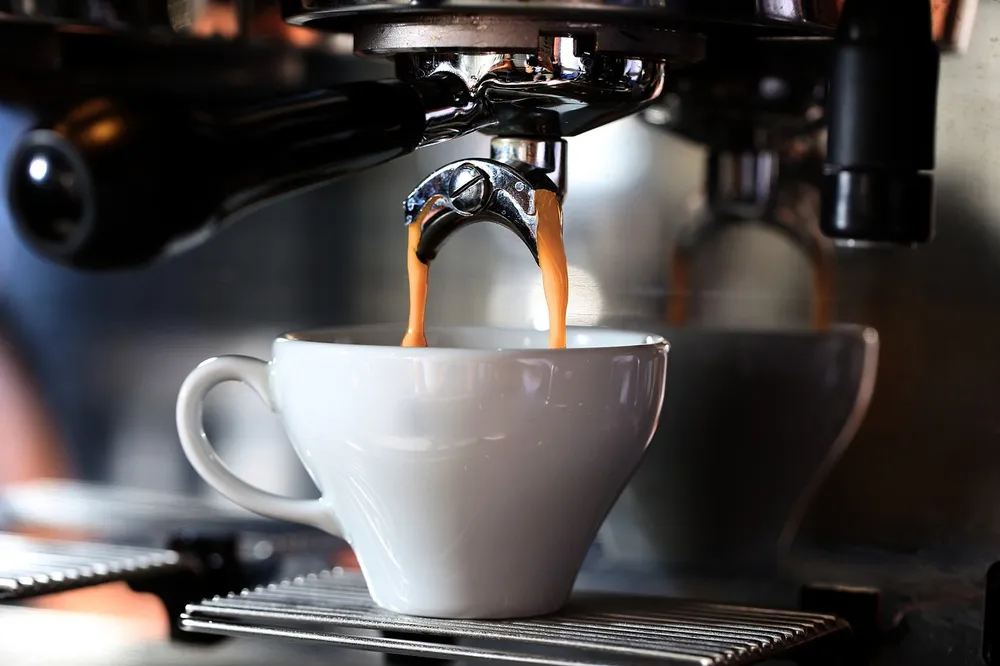
The graphic below summarizes the three types side by side. The table underneath holds the same comparison in text.
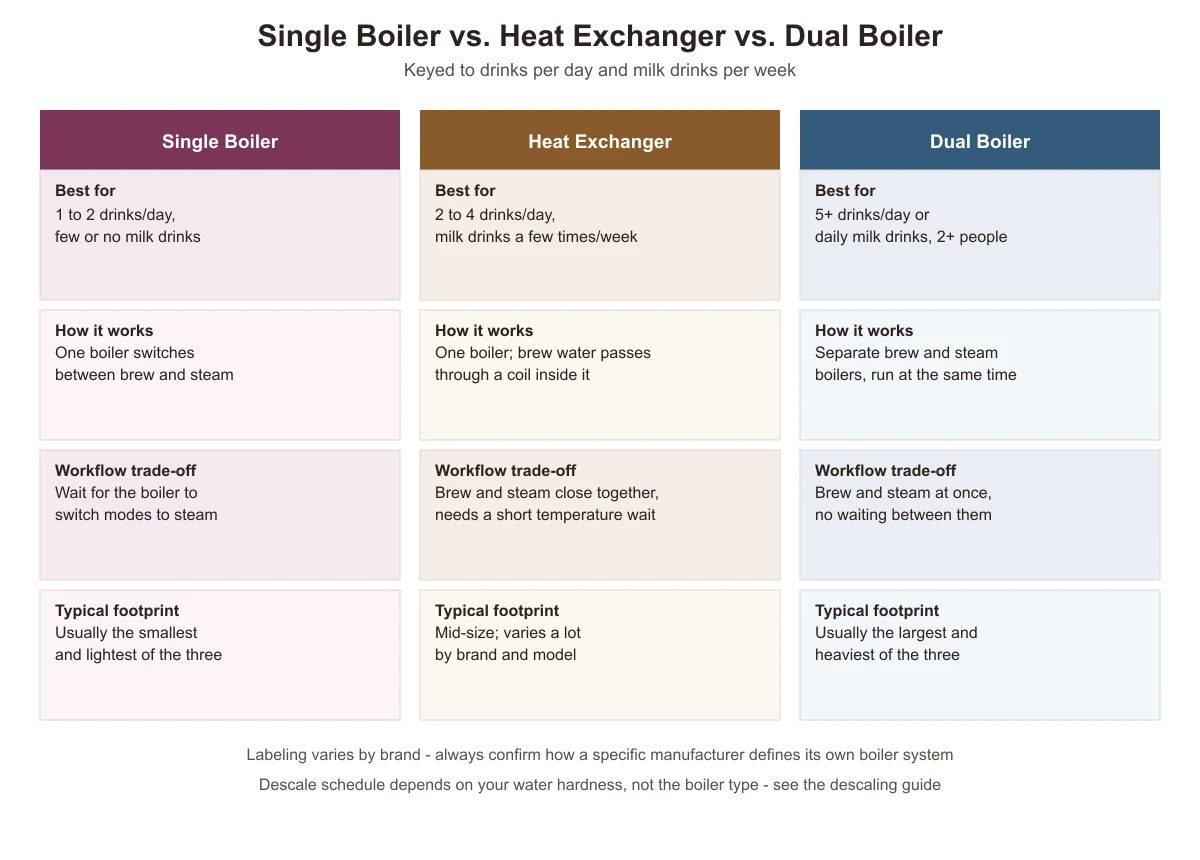
| Single Boiler | Heat Exchanger | Dual Boiler | |
|---|---|---|---|
| Best for | 1–2 drinks/day, few or no milk drinks | 2–4 drinks/day, milk drinks a few times a week | 5+ drinks/day, or daily milk drinks with 2+ people |
| How it works | One boiler switches between brew and steam | One boiler; brew water passes through a coil inside it | Separate brew and steam boilers run at the same time |
| Workflow trade-off | Wait for the boiler to switch modes to steam | Brew and steam close together; short temperature wait | Brew and steam at once, no waiting between them |
| Published example | Rancilio Silvia, 0.3 L boiler | Rocket Espresso Appartamento, 1.80 L boiler, 20 kg | La Marzocco Linea Mini, 3 L steam boiler, 29.93 kg |
Frequently asked questions
Does a dual boiler need descaling more often than a single boiler?
No source we found publishes a boiler-type-specific descale multiplier, so we’re not inventing one. Descale frequency depends on your water hardness, not boiler count — see the descaling frequency guide for a schedule based on water hardness in parts per million.
Is a heat exchanger just a cheaper dual boiler?
Not exactly. A heat exchanger still has one physical boiler, while a dual boiler has two independent ones. A heat exchanger closes most of the brew-then-steam wait without the cost, size, and complexity of running two boilers, but it can’t brew and steam at the truly same moment the way a dual boiler can.
Why does Rancilio call the Silvia’s boiler a “heat exchange boiler” if it isn’t one?
That’s the manufacturer’s own wording on its North American product page, but it doesn’t match how the espresso industry conventionally defines a heat exchanger (a separate coil for brew water running through a steam boiler). The Silvia’s single boiler switches between brew and steam by thermostat, which is the single-boiler design, regardless of the label on the page.
Can I add a second boiler to a single-boiler machine later?
No. Boiler configuration is built into the machine and isn’t something you can add or retrofit. If you expect your milk-drink habit to grow, it’s worth buying for that future routine rather than upgrading the boiler type later.
Sources
- Rancilio Group North America, Silvia product page and manual — ranciliogroupna.com
- Rocket Espresso, Appartamento product page — rocket-espresso.com
- La Marzocco, Linea Mini product page — lamarzocco.com
espressomachinesforhome.com Editorial Team. Last updated: November 13, 2026.