Choosing a home espresso machine comes down to four things working together: how many drinks you make each day, how much control you want over the shot, whether you need steam for milk, and what your counter can actually hold. Most guides rank machines by price. This one walks through all four factors at once, with a decision flow you can follow in order.
- Daily drink count narrows you to manual lever, semi-automatic, or super-automatic.
- How often you steam milk points you toward a single boiler, heat exchanger, or dual boiler.
- Budget tier changes what you get within each type, not just the brand name on the front.
- Counter footprint and clearance rule out machines before boiler type even matters.
- A built-in grinder changes the long-term repair picture, not just the up-front price.
How many espresso drinks do you make each day?
Start here, because drink count affects everything else. If you make one espresso most days, you don’t need a machine built for a household that drinks five cappuccinos before 8 a.m. Buying for the volume you actually have avoids paying for capacity you won’t use, and avoids cramming a machine built for speed onto a counter meant for something simpler.
A rough starting point: one drink or fewer most days fits a manual lever machine or a simple semi-automatic. Two to four drinks a day fits most semi-automatic pump machines comfortably. Five or more drinks a day, or more than one person making drinks around the same time, is where a dual boiler or a super-automatic earns its larger footprint and higher price.
How much control do you want over the shot?
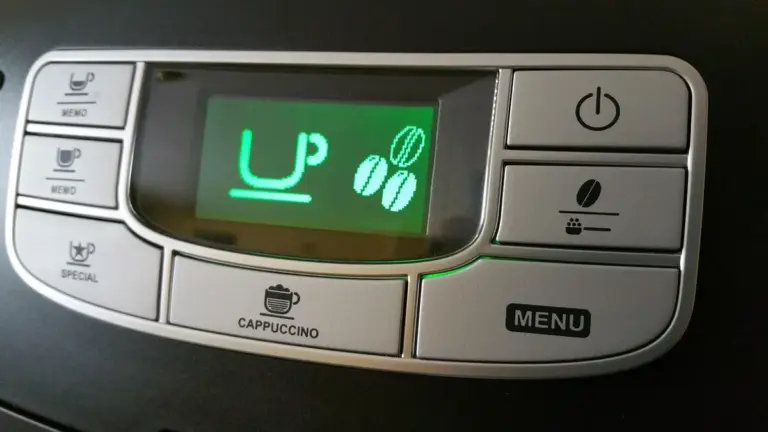
This is the real fork in the road, more than price. A manual lever machine puts pressure entirely in your hands — there is no pump and no electronic pressure control, so every shot depends on how you pull the lever. A semi-automatic uses a pump to hold pressure steady, which means a grinder, dose, and tamp still matter, but the pressure curve itself doesn’t depend on your arm. A super-automatic goes further and grinds, doses, and often tamps for you at the push of one button.
None of these is “better.” A manual lever rewards a buyer who wants to learn the mechanics of extraction. A super-automatic rewards a buyer who wants consistent output with the least daily attention. If you’re deciding specifically between a manual lever and a semi-automatic as a beginner, the manual lever vs. semi-automatic comparison breaks down what each one teaches you and what tends to wear out over time. If your choice is between a semi-automatic and a super-automatic, the semi-automatic vs. super-automatic guide has a decision table built around daily cups, counter space, budget, and how much cleanup you can tolerate.
Which boiler type matches your milk-drink habit?
Boiler type decides whether you can steam milk and brew at the same time, and how long you wait between the two. A single boiler switches between brewing temperature and steam temperature, so you brew, wait, then steam. A heat exchanger keeps a separate steam reservoir but brews through a coil running through it, letting brewing and steaming happen closer together. A dual boiler runs two independent boilers, so you can brew and steam at the same moment with no mode switch at all.
If milk drinks are rare in your house, the wait built into a single boiler barely matters. If you make a latte or cappuccino most mornings, a heat exchanger removes most of the delay. If two people want drinks back-to-back, or you make several milk drinks in a row, a dual boiler is the only one of the three that doesn’t make you wait. The single boiler vs. dual boiler vs. heat exchanger guide covers all three side by side, keyed to drinks per day and milk drinks per week.
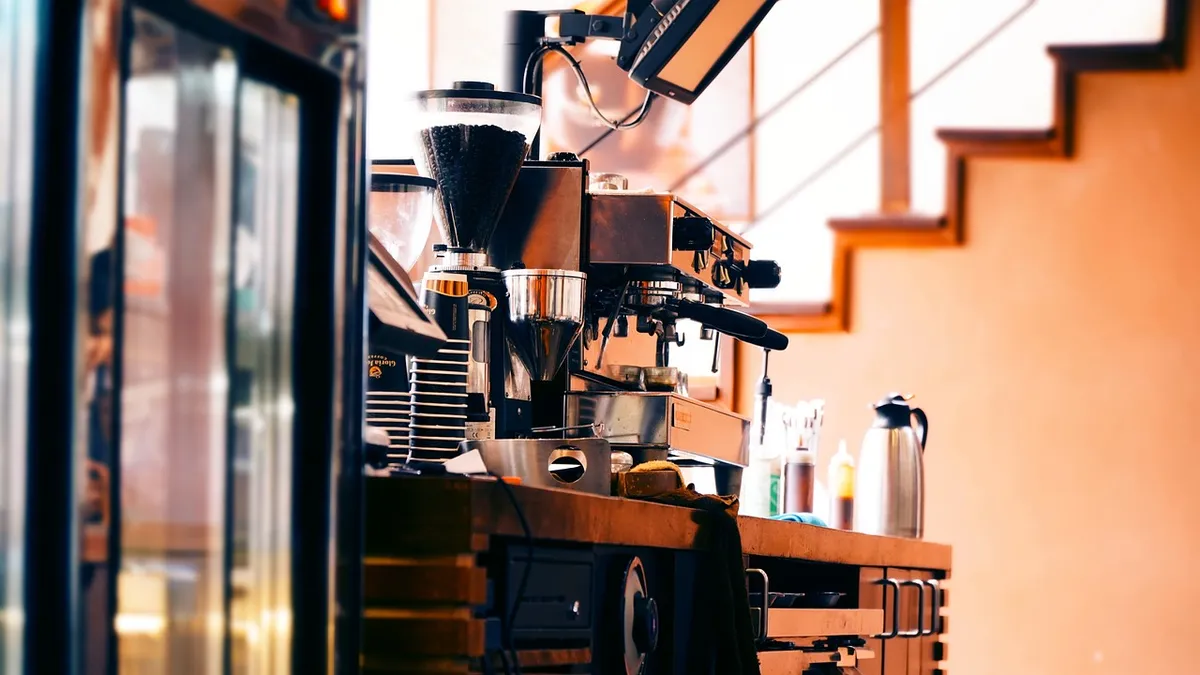
What do real machines in each category actually look like?
Specification sheets make more sense once you see them next to each other. The table below uses six machines, each one a published example of a type and boiler combination, with dimensions and specs read directly from each manufacturer’s own product page or manual.
| Machine (example) | Type | Boiler | Dimensions (W × D × H) | Weight |
|---|---|---|---|---|
| Breville Barista Express (BES870) | Semi-automatic, built-in grinder | Single boiler (thermocoil) | 313 × 338 × 407 mm | no data |
| Gaggia Anima Prestige | Super-automatic | Single boiler (internal) | 8.7 × 16.9 × 13.4 in | 25 lb |
| Rancilio Silvia | Semi-automatic | Single boiler, thermostat-switched | no data (see note below) | no data |
| Rocket Espresso Appartamento | Semi-automatic | Heat exchanger | 274 × 439.5 × 360 mm | 20 kg |
| La Marzocco Linea Mini | Semi-automatic | Dual boiler | 355.6 × 457.2 × 381 mm | 29.93 kg |
| La Pavoni Professional Lusso | Manual lever | Single boiler | 200 × 350 × 490 mm | 6.5 kg net |
A note on the Rancilio Silvia: Rancilio’s own North American product page describes the Silvia’s 0.3-liter insulated brass boiler as a “heat exchange boiler,” but that wording is misleading. The Silvia has one boiler that switches between brew and steam duty by thermostat — it has no separate steam boiler and no heat-exchanger coil, so it’s conventionally classified as a single-boiler machine, not a true heat exchanger like the Rocket Appartamento above. Rancilio’s official page does not publish full external dimensions; a secondary manual-hosting source lists approximate figures, but we’re not reusing an unverified number here — check the official PDF manual directly before relying on an exact dimension for this specific model.
How much counter space does each type actually need?
Width on a spec sheet is only part of the footprint. Depth, clearance above the machine, and reservoir access all matter once the machine is sitting on your counter every day. A compact-looking machine can still need a tall clearance for the reservoir lid, or enough side room for the steam wand to swing into a pitcher. The counter space and clearance guide reconciles the conflicting clearance numbers you’ll find across different sources into one measurement checklist.
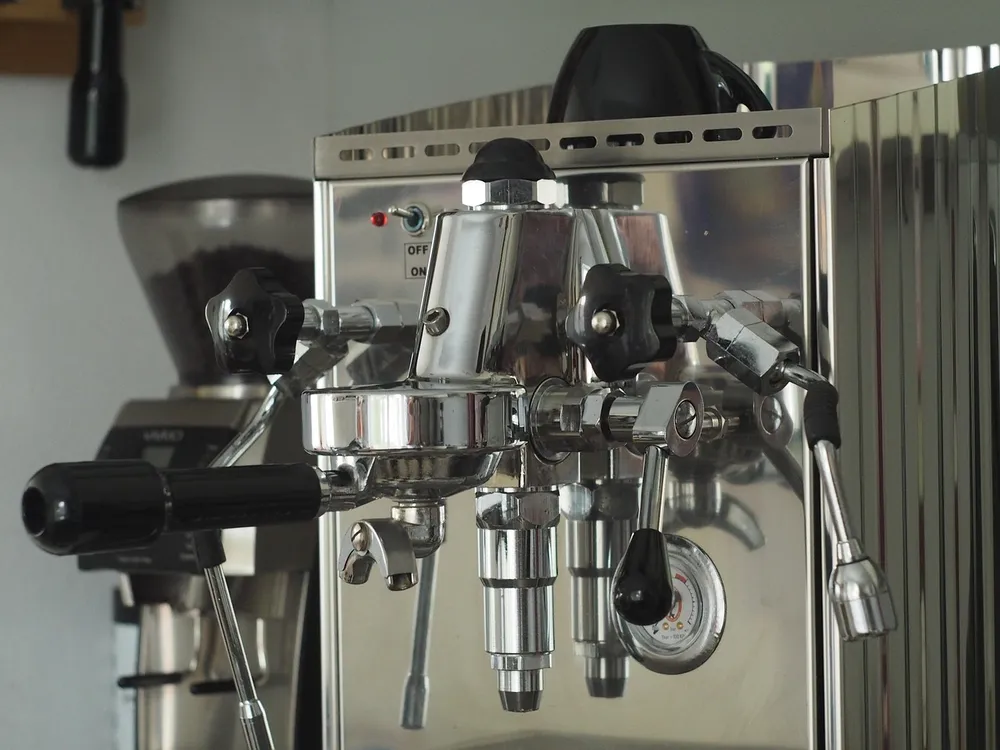
What does budget tier actually change?
Price mostly buys three things: build quality and thermal stability, the number of boilers, and whether a grinder is included. A low-cost semi-automatic with a thermocoil, like the Breville Barista Express, bundles a grinder into a compact single-boiler machine. A dual-boiler prosumer machine like the La Marzocco Linea Mini costs more because it runs two boilers and higher-grade components, not because of a brand premium alone. A super-automatic’s price reflects the grinding, dosing, and often tamping hardware packed inside one case.
A built-in grinder is worth thinking about past the purchase price, too. If the grinder fails on a super-automatic, it’s typically one combined repair call, because the parts are integrated. A standalone grinder next to a semi-automatic machine can be serviced or replaced on its own. The built-in vs. separate grinder guide compares what each path costs to repair over time, not just to buy.
Putting it together: a four-step decision flow
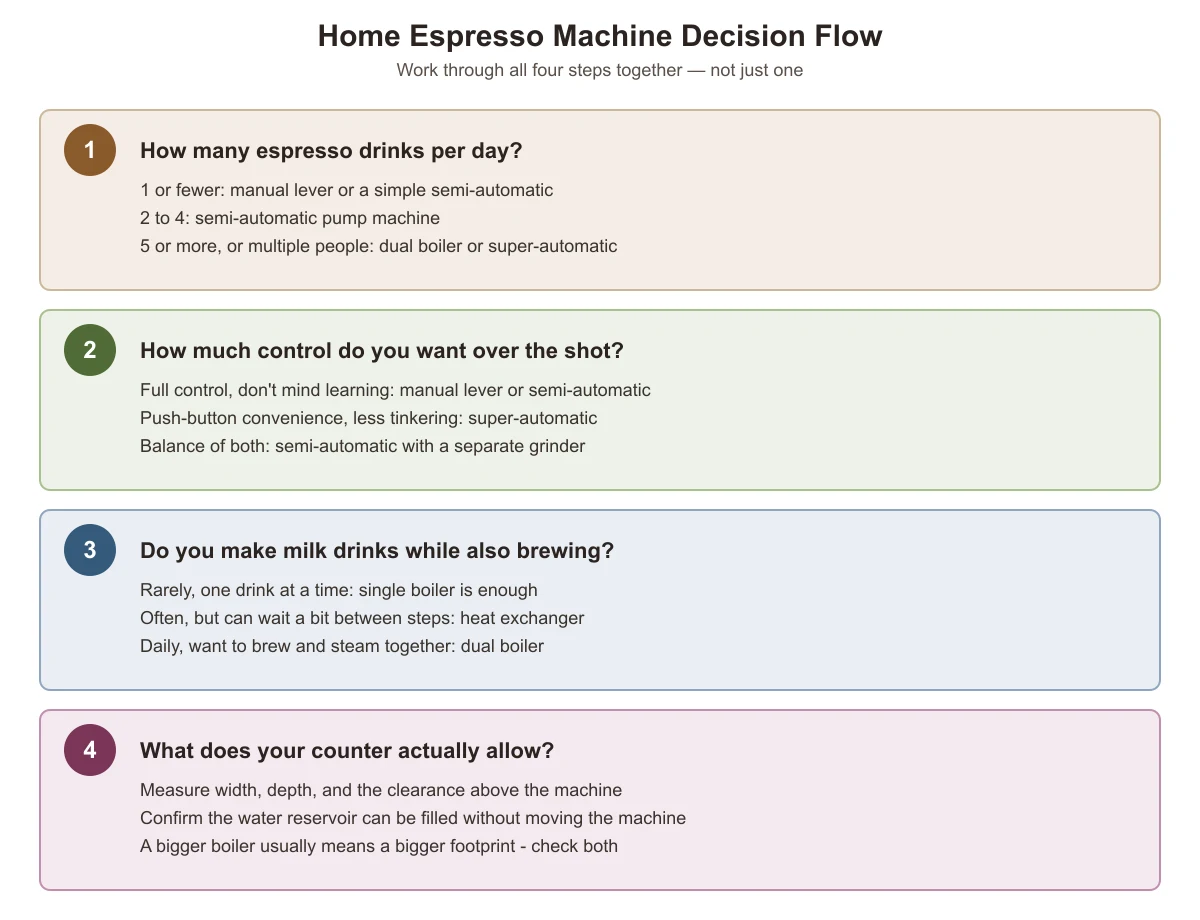
The graphic below walks through the four questions in order. The table underneath holds the same information in text, since search engines and screen readers can’t read text baked into an image.
| Step | Question | What it points to |
|---|---|---|
| 1 | How many espresso drinks per day? | 1 or fewer: manual lever or simple semi-automatic. 2–4: semi-automatic. 5+ or multiple people: dual boiler or super-automatic. |
| 2 | How much control do you want over the shot? | Full control: manual lever or semi-automatic. Push-button convenience: super-automatic. Balance: semi-automatic with a separate grinder. |
| 3 | Do you make milk drinks while also brewing? | Rarely: single boiler is enough. Often, can wait a bit: heat exchanger. Daily, at the same time: dual boiler. |
| 4 | What does your counter actually allow? | Measure width, depth, and clearance above the machine, and confirm reservoir access before boiler type tips the decision. |
Frequently asked questions
Is a more expensive espresso machine always better for a beginner?
Not necessarily. A more expensive machine usually means more boilers, sturdier components, or a built-in grinder, not automatically a better learning experience. A beginner who wants to understand extraction may get more out of a simpler, cheaper semi-automatic than an expensive super-automatic that automates the steps worth learning.
Do I need a dual boiler if I only drink one espresso a day?
No. A dual boiler’s advantage is brewing and steaming at the same time, which matters most for households making several milk drinks back to back. For one drink a day, a single boiler or heat exchanger machine covers the need without the extra size, cost, or water-quality attention a dual boiler usually asks for.
Does a bigger boiler always mean a bigger machine?
Generally yes, though not perfectly. Comparing the published dimensions above, the dual-boiler La Marzocco Linea Mini and the heat-exchanger Rocket Appartamento are both heavier and deeper than the single-boiler Breville Barista Express or the manual-lever La Pavoni Professional Lusso. Always check a specific model’s own listed dimensions rather than assuming by boiler type alone.
What’s the single biggest mistake first-time buyers make?
Picking based on price or appearance before checking counter fit and daily drink habits. A machine that looks compact in photos can still need more vertical clearance than a kitchen allows, and a feature-packed machine bought for occasional use often goes unused because it demands more routine than the buyer wanted.
Sources
- Breville official instruction manual, Barista Express BES870 — breville.com
- Gaggia North America, Anima Prestige product page — gaggia-na.com
- La Marzocco, Linea Mini product page — lamarzocco.com
- Rancilio Group North America, Silvia product page and manual — ranciliogroupna.com
- Rocket Espresso, Appartamento product page — rocket-espresso.com
- La Pavoni, Professional Lusso product page — lapavoni.com
espressomachinesforhome.com Editorial Team. Last updated: November 13, 2026.