A built-in grinder (super-automatic) is simpler to own but bills every repair as one flat-rate service call, typically $300 to $400 no matter which internal part failed. A separate machine plus a standalone grinder costs more up front and takes more counter space, but each part is repaired and billed on its own, which can be cheaper for a single fault or more expensive if several parts wear out at once.
Key takeaways
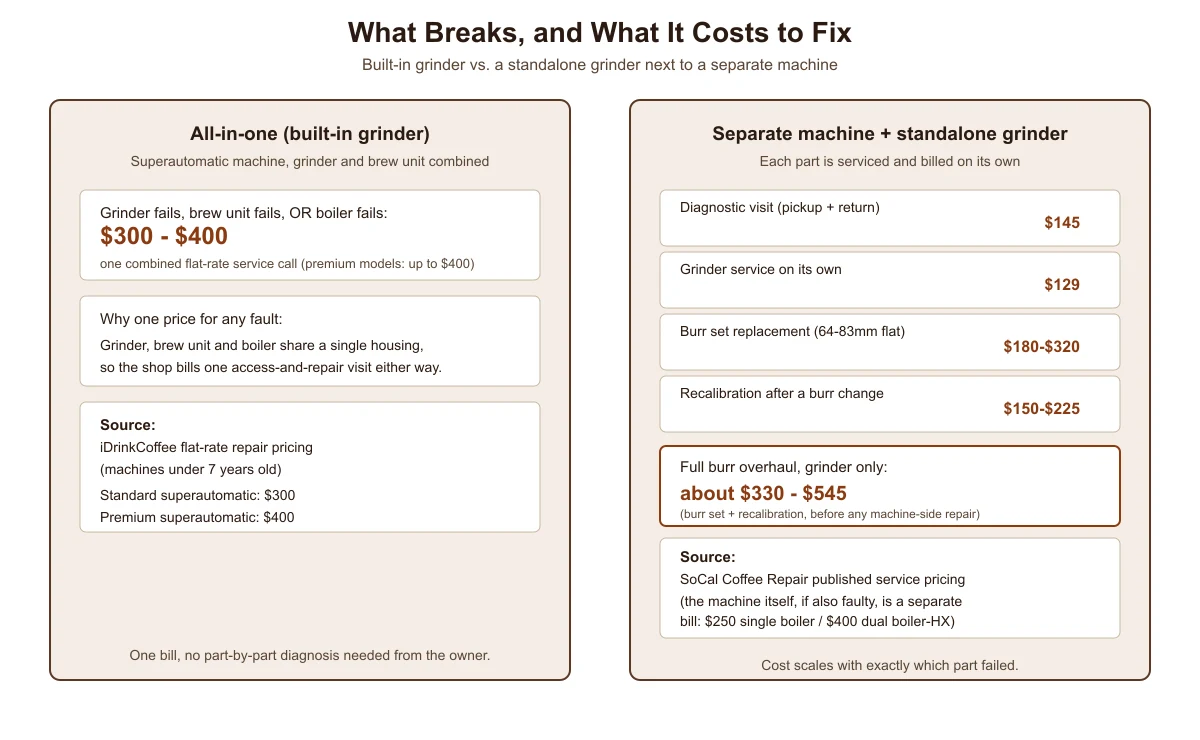
- On an all-in-one superautomatic, a failed grinder, brew unit, or boiler is billed as one combined repair: about $300 to $400, per published flat-rate pricing.
- A standalone grinder’s costs scale with the specific part: a diagnostic visit, grinder service, burr replacement, and recalibration are each billed separately.
- A full burr overhaul on a standalone grinder (burr set plus recalibration) runs roughly $330 to $545, before any separate repair to the espresso machine itself.
- Built-in grinders cannot be swapped for a different grind quality later; a standalone grinder can be upgraded independently of the machine.
- Think about repair cost and upgrade flexibility together with daily convenience, not convenience alone.
What’s the real difference between built-in and separate grinders?
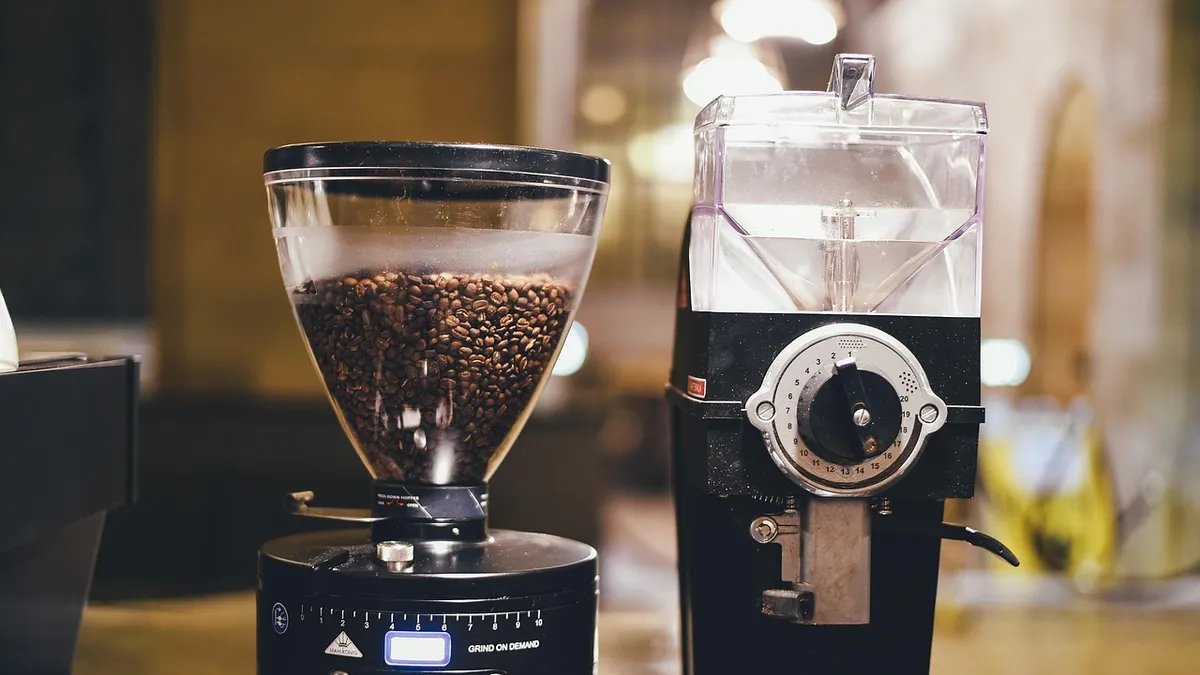
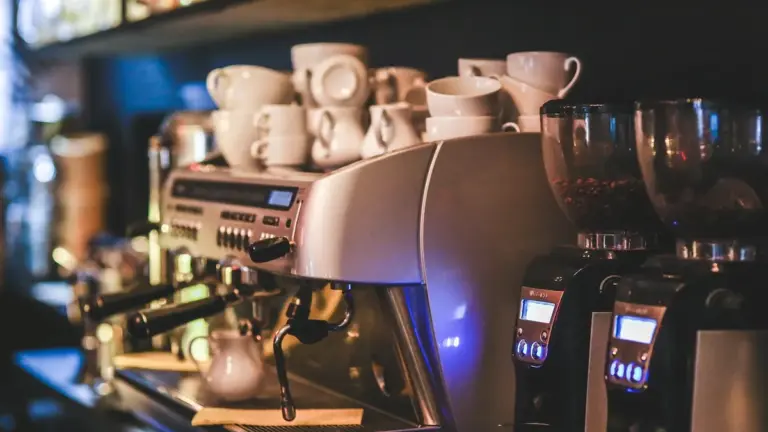
A built-in grinder is part of a super-automatic machine: beans go in a hopper on top of the same unit that brews the shot, and one control panel runs both the grind and the brew cycle. A separate setup uses two devices: a standalone grinder that dispenses ground coffee into a portafilter, and a brewing-only machine. If you’re not sure where a built-in grinder fits in the bigger machine-type decision, start with the home espresso machine buying guide, or go straight to semi-automatic vs. super-automatic: which should you buy, since “super-automatic” is the category that always includes a built-in grinder.
The convenience trade-off between those two is well covered elsewhere. What’s missing from most comparisons is what happens, in dollars, when either setup breaks.
What does it cost to fix a built-in grinder?
According to iDrinkCoffee’s published flat-rate repair pricing for machines under seven years old, a standard super-automatic repair runs about $300, and a premium super-automatic repair runs about $400. That price is not specific to the grinder. The same flat rate applies whether the fault turns out to be the grinder burrs, the brew unit, or the boiler, because all three components share a single housing and the shop bills one access-and-repair visit regardless of which part is actually at fault.
This is the central trade-off for an all-in-one machine: you get one predictable number ($300 to $400) for almost any internal failure, but you have no way to repair only the cheaper part. A minor grinder issue and a major boiler issue cost roughly the same to fix, because the labor to open the unit is the larger share of the bill.
What does it cost to fix a standalone grinder?
SoCal Coffee Repair’s published service pricing breaks a standalone grinder repair into separate line items:
- Diagnostic visit, including pickup and return: $145
- Grinder service on its own: $129
- Burr set replacement (64 to 83 mm flat burrs): $180 to $320
- Recalibration (“zero and grind reference”) after a burr change: $150 to $225
Add those up and a full burr overhaul, just for the grinder, lands around $330 to $545 before the espresso machine itself is touched. If the machine also needs work, that’s a separate bill entirely: iDrinkCoffee’s flat rates list $250 for a single-boiler machine and $400 for a dual-boiler or heat-exchanger machine.
So a standalone setup can be cheaper than an all-in-one repair if only a minor grinder issue (like a basic service call at $129) comes up. It can also stack higher than the all-in-one’s flat rate if the grinder needs a full burr overhaul and the machine separately needs boiler work in the same year.
| Scenario | Built-in grinder (superautomatic) | Standalone grinder + separate machine |
|---|---|---|
| Any single internal fault (grinder, brew unit, or boiler) | $300-$400 flat rate, one visit | Varies by part; see rows below |
| Basic grinder service only | Included in the $300-$400 flat rate | $129 |
| Diagnostic visit | Included in the flat rate | $145 |
| Full burr set replacement | Included in the flat rate | $180-$320 |
| Recalibration after burr change | Included in the flat rate | $150-$225 |
| Machine-side repair (boiler, brew unit), if also needed | Same visit, same flat rate | Separate bill: $250 single boiler / $400 dual boiler-HX |
Does a built-in grinder affect grind quality?
This article covers the machine side of the decision: what breaks, what it costs, and how repairs are billed. Grind consistency, dose accuracy, and tamping technique are a separate topic from machine selection, and are outside what this guide covers.
Can you upgrade a standalone grinder without replacing the machine?
Yes, and that is the other half of this trade-off. A standalone grinder is a separate purchase from the brewing machine, so you can replace or upgrade the grinder on its own schedule and budget. A built-in grinder is fused to the machine’s housing and control board; if you want a different grinder, you generally need a different machine. If you’re still deciding which brewing side (semi-automatic, dual boiler, heat exchanger, or manual lever) fits your routine, the manual lever vs. semi-automatic comparison for beginners is a useful next read before you commit to a separate-grinder setup.
Frequently asked questions
Is a built-in grinder cheaper to own overall?
It depends on what breaks. The built-in setup has one predictable repair cost ($300 to $400) regardless of which part fails, which is cheaper than a standalone grinder’s full burr overhaul alone ($330 to $545). But a standalone grinder’s basic service ($129) or a diagnostic-only visit ($145) can be far cheaper than the all-in-one’s flat rate if the fix turns out to be minor.
Why does a superautomatic repair cost the same no matter what’s wrong?
Because the grinder, brew unit, and boiler share one sealed housing. According to iDrinkCoffee’s pricing, the shop bills a single access-and-repair visit for machines under seven years old, so the labor to open and diagnose the unit is a larger share of the bill than the specific part replaced.
How often does a standalone grinder’s burr set need replacing?
No source used for this article gives a specific burr lifespan in cups or months, so that figure is “no data” here. Treat the $180 to $320 burr replacement and $150 to $225 recalibration figures as what to budget for when the burrs do eventually need swapping, not a fixed replacement interval.
Does the built-in grinder’s flat-rate price include parts?
iDrinkCoffee’s published pricing describes flat-rate labor pricing; it does not specify whether replacement parts are itemized separately on top of that rate. Confirm what is and is not included in the quoted price directly with whichever repair shop services your machine before assuming the $300 to $400 figure is a hard ceiling.
Is a separate grinder worth the extra counter space it takes up?
That depends on your kitchen. A standalone grinder adds a second footprint next to the machine. See how much counter space does an espresso machine need for confirmed width and depth figures to check against your own counter before deciding.
Sources
espressomachinesforhome.com Editorial Team. Last updated: November 13, 2026.


2 thoughts on “Built-In vs Separate Grinder: Which Should You Buy?”