Descale a home espresso machine monthly if your water is moderately hard, hard, or very hard, and quarterly if your water is soft, based on Breville’s own instruction manual guidance mapped against the official USGS water-hardness scale. Check your water hardness first; your descaling schedule should follow your actual water, not a one-size-fits-all calendar reminder.
Key takeaways
- Breville’s BES870 instruction manual gives a simple two-tier rule: hard water means descale monthly, soft water means descale quarterly.
- The USGS classifies water hardness into four official bands, measured in mg/L as calcium carbonate (CaCO3): soft, moderately hard, hard, and very hard.
- Converting grains-per-gallon hardness readings to the USGS mg/L scale uses a simple factor: 1 grain per gallon is about 17.1 mg/L, per the Water Quality Association.
- No cited source gives a separate descaling multiplier for dual-boiler or heat-exchanger machines; treat any claim that they need descaling twice as often as unverified unless your specific model’s manual says so.
- Find out your own water’s hardness number (test strip or your local water utility’s annual report) before picking a schedule.
Descaling is an ongoing maintenance cost worth factoring in before you buy, not just after. If you’re still comparing machine types, the home espresso machine buying guide covers this alongside the other budget and space trade-offs.
Why does water hardness decide the descaling schedule?
Limescale is the mineral residue (mostly calcium carbonate) left behind when hard water evaporates or heats repeatedly inside a boiler. The harder the water, the faster that residue builds up on heating elements, inside tubing, and around valves. A home espresso machine heats the same small volume of water over and over, so even a moderate mineral load accumulates faster than it would in, say, a drinking glass. That’s why manufacturer descaling guidance is tied to water hardness rather than a flat number of months for every household.
What do the official hardness bands mean?
The U.S. Geological Survey’s Water Science School publishes an official classification of water hardness, measured in milligrams per liter (mg/L) as calcium carbonate:
| USGS hardness class | mg/L as CaCO3 | Approx. grains per gallon |
|---|---|---|
| Soft | 0 – 60 | 0 – 3.5 |
| Moderately hard | 61 – 120 | 3.6 – 7.0 |
| Hard | 121 – 180 | 7.1 – 10.5 |
| Very hard | more than 180 | more than 10.5 |
If your water utility or test strip reports hardness in grains per gallon (gpg) rather than mg/L, the Water Quality Association’s cited conversion factor (1 grain per gallon is about 17.1 mg/L) lets you translate that reading onto the USGS scale above. The WQA also notes that NSF/ANSI Standard 44 and Standard 330 define “soft” water as containing less than 1 grain per gallon (under about 17.1 mg/L), which fits inside the USGS “soft” band.
How often should you actually descale, by hardness level?
Breville’s official BES870 instruction manual gives a direct, manufacturer-stated rule: descale monthly if your water is hard, and quarterly if your water is soft. That’s the only manufacturer-direct descaling-frequency figure used in this article; no other source here is treated as authoritative on timing.
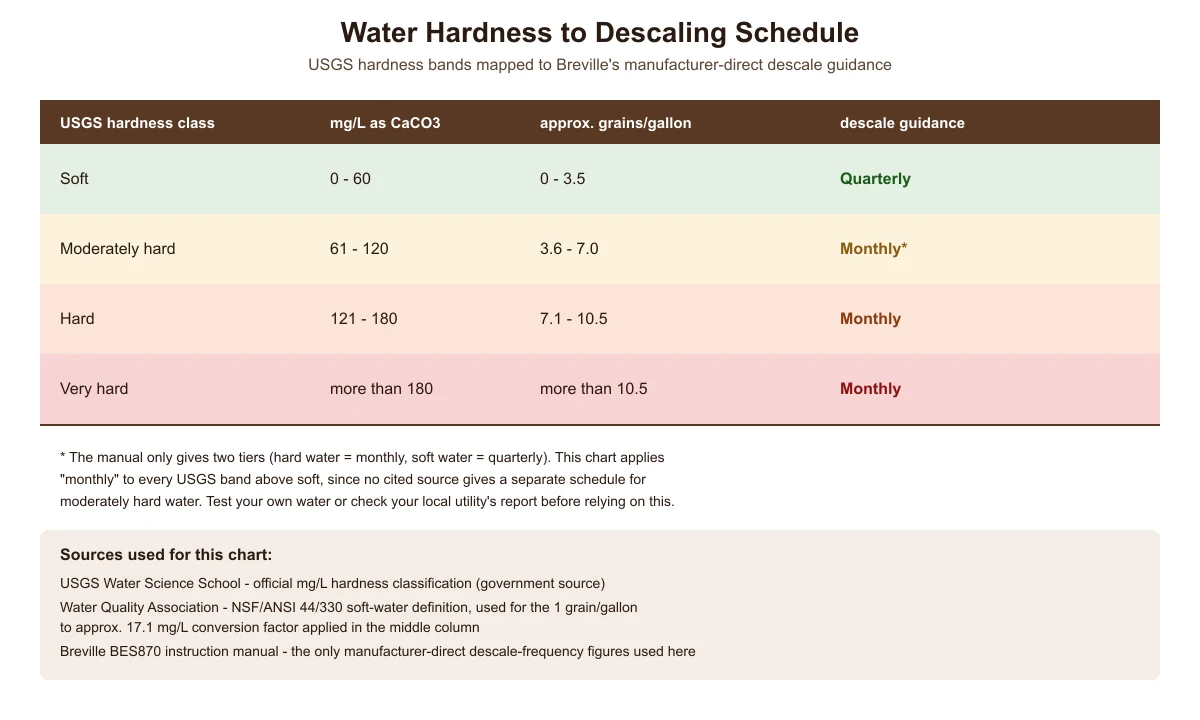
The manual’s rule is binary (hard vs. soft), while the USGS scale has four bands. Mapping one onto the other requires a judgment call, which this article makes explicitly rather than inventing a more granular schedule that no source actually supports: soft water (USGS 0-60 mg/L) follows the manual’s quarterly case, and everything above soft (moderately hard, hard, and very hard) follows the manual’s monthly case, since the manual gives no separate guidance for the middle tier.
| USGS hardness class | mg/L as CaCO3 | Approx. grains/gallon | Descale guidance |
|---|---|---|---|
| Soft | 0 – 60 | 0 – 3.5 | Quarterly |
| Moderately hard | 61 – 120 | 3.6 – 7.0 | Monthly* |
| Hard | 121 – 180 | 7.1 – 10.5 | Monthly |
| Very hard | more than 180 | more than 10.5 | Monthly |
* Applied from the manual’s two-tier rule, since no cited source gives a separate figure for moderately hard water specifically.
Does boiler type change how often you should descale?
No source used for this article gives a boiler-type-specific descaling multiplier. It’s common to see a claim online that dual-boiler or heat-exchanger machines need descaling more often than single-boiler machines because they hold more water in more places, but no manufacturer manual checked here backs that up with a specific number. If you own a dual-boiler or heat-exchanger machine, follow that model’s own manual, and treat the water-hardness schedule above as the baseline until your manufacturer states otherwise. For background on what’s actually different between those boiler types day to day, see single boiler vs. dual boiler vs. heat exchanger: which do you need.
How do you find out your own water’s hardness?
Three practical ways to check, in order of reliability:
- Your local water utility’s annual water quality report. Most public water utilities publish hardness figures, often in mg/L or grains per gallon, in their yearly consumer confidence report.
- A home water hardness test strip. These give a quick approximate reading in grains per gallon or mg/L, which you can then compare to the USGS bands above.
- Ask your municipal water department directly if you can’t find a published report online.
If you skip this step and guess, the safer default is the manual’s shorter interval (monthly) rather than the longer one, since under-descaling risks scale damage while over-descaling mainly costs a bit of extra descaling solution and time.
What happens if you skip descaling?
Left unaddressed, scale buildup narrows internal tubing, coats heating elements, and can interfere with valves and pumps. That’s also one of the root causes behind machines that gradually lose pressure or stop heating properly; see espresso machine won’t build pressure: causes and fixes and espresso machine leaking water from the bottom: causes and fixes for how scale buildup shows up as those specific symptoms.
Frequently asked questions
What’s the difference between cleaning and descaling?
Cleaning removes coffee oil and grounds residue from the portafilter, group head, and drip tray, usually daily or weekly. Descaling removes mineral scale from inside the boiler and water lines using a descaling solution, on the monthly-to-quarterly schedule covered in this article. They address different buildups and neither one replaces the other.
Can I use vinegar instead of a commercial descaling solution?
This article does not recommend a specific descaling product since no manufacturer page checked here confirmed vinegar’s safety for internal boiler components across machine brands; follow your machine’s own manual for an approved descaling solution. If you ever use vinegar or any other cleaning chemical near your machine, never mix it with chlorine bleach or ammonia-based cleaners, since combining those produces dangerous fumes.
Does bottled or filtered water mean I never need to descale?
No source used for this article confirms that any filtered or bottled water eliminates scale buildup entirely; filtration can reduce mineral content but your machine’s manual descaling schedule is still the reference point unless that manual states otherwise for filtered water specifically.
Is a water softener attachment a substitute for descaling?
No official source checked for this article confirms that a softener attachment eliminates the need for scheduled descaling on a home espresso machine; treat that as “no data” and continue to follow your machine’s own manual-stated schedule even if you add water treatment.
How do I know if my machine already has scale buildup?
Common signs include slower brewing, reduced steam pressure, unusual noise from the pump, or visible white residue around the water tank or steam wand. If you’re troubleshooting a specific symptom like weak pressure, the hardware-side checklist in espresso machine won’t build pressure: causes and fixes covers scale alongside the other usual suspects.
Sources
- Breville Barista Express (BES870) official instruction manual
- USGS Water Science School: hardness of water
- Water Quality Association: scale deposits
espressomachinesforhome.com Editorial Team. Last updated: November 13, 2026.

One thought on “How Often Should You Descale an Espresso Machine”