A manual lever machine is right for a beginner who wants to learn how pressure and extraction actually work and doesn’t mind a slower, hands-on routine. A semi-automatic is right for a beginner who wants a pump to hold pressure steady while they focus on grind, dose, and timing. Both can make excellent espresso — they teach different skills and wear differently over time.
- A lever machine has no pump, no over-pressure valve (OPV), and no electronic pressure control — pressure comes entirely from your arm.
- A semi-automatic uses an electric pump to hold brew pressure steady shot after shot.
- Fewer moving parts on a lever machine means fewer long-term failure points, but more technique to learn.
- A semi-automatic’s pump and OPV are wear parts that eventually need service, especially with hard water.
What does each type actually teach you?
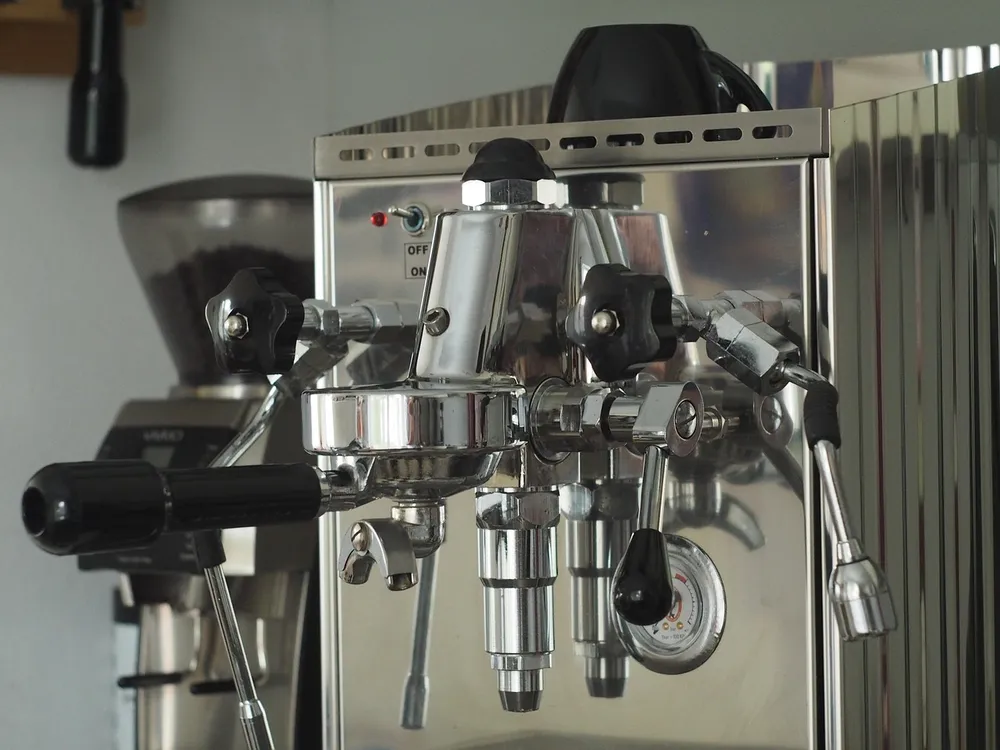
A manual lever machine puts you in direct contact with the puck. The La Pavoni Professional Lusso is a published example: a 1.6-liter boiler, 200 × 350 × 490 mm, 6.5 kg net weight, 950 W at 220–240V, according to La Pavoni’s own product page. There’s no pump and no electronic pressure control on a machine like this — you pull the lever down, and the pressure you apply is the pressure the puck sees. That gives you direct feedback on puck resistance that a pump-driven machine filters out.
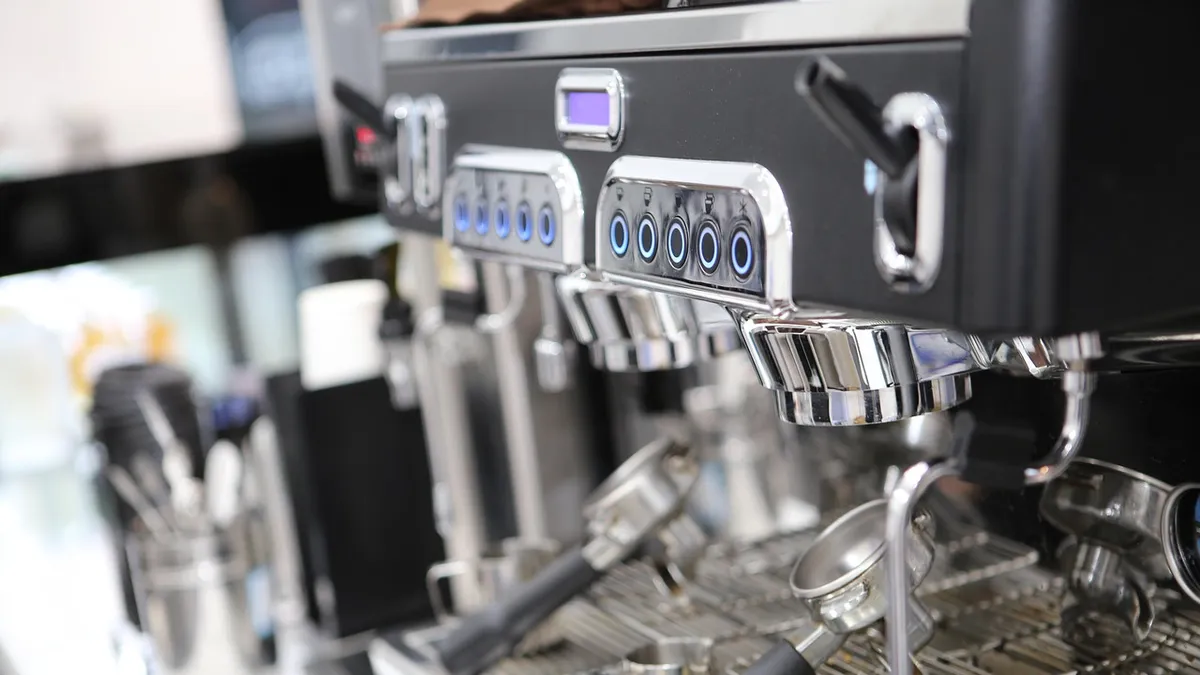
A semi-automatic like the Breville Barista Express (313 × 338 × 407 mm, per Breville’s own instruction manual) uses a pump to hold pressure around a target level automatically. You still control grind size, dose, and tamp, and you still decide when to start and stop the shot, but the pump removes pressure consistency as a variable you have to manage by hand. That makes it easier to isolate and learn one variable — grind size, for example — without pressure swings muddying the result.
How does the daily routine actually differ?
A lever machine asks for your full attention for the length of the pull — you can’t walk away mid-shot the way you might glance away during a pump-driven brew. That slower pace suits someone who treats making espresso as part of the routine itself, not just a step before drinking it. A semi-automatic is faster in practice: start the pump, and it holds pressure while you handle other things, like steaming milk or rinsing the portafilter from the last round.
Neither pace is wrong. A beginner who wants espresso-making to be a short morning ritual usually prefers the semi-automatic’s speed. A beginner who wants to understand why a shot runs fast or slow, and likes the process of fixing it by hand, often prefers the lever.
What actually breaks over time, and why it matters for a beginner?
This is the long-term angle most beginner comparisons skip. A manual lever machine like the La Pavoni Professional Lusso has no pump and no electronic pressure control, so there’s no OPV and no pump to wear out or fail — pressure comes entirely from the user pulling the lever. Fewer parts means fewer things that can break from age or hard water.
A semi-automatic’s pump and OPV are different. According to repair-technician explanations published by Grindset.cafe, home machines typically use vibratory pumps with a service life of roughly 500 to 1,000 hours, wearing out faster in hard-water environments where scale accumulates internally. The OPV is a spring-loaded relief valve that limits maximum pump pressure; when its spring weakens or the valve seat fouls, it can open prematurely and bleed off pressure before the puck ever sees it. A worn group-head gasket is a third common wear point, and on E61-style group heads specifically, it should be replaced once it compresses below roughly 7 mm or shows visible cracking, per the same source. None of these failure modes exist on a lever machine, because there’s no pump, OPV, or pressure electronics to wear out in the first place — though a lever machine still has its own boiler, seals, and gaskets that need normal upkeep over time.

So which one should a beginner actually buy?
If you want the lowest long-term maintenance complexity and don’t mind a slower, hands-on shot, the lever is worth the learning curve. If you want a shorter learning curve on pressure control specifically, and are fine servicing a pump and OPV years down the road, the semi-automatic is the easier start. If you later decide a semi-automatic’s built-in grinder matters to you as well, the built-in vs. separate grinder guide covers that follow-up decision, including long-term repair cost.
This choice is one piece of a larger decision. The home espresso machine buying guide walks through drink count, control preference, boiler type, and counter space together, and the semi-automatic vs. super-automatic comparison covers the next step up if full automation interests you later.
What each type teaches you, side by side
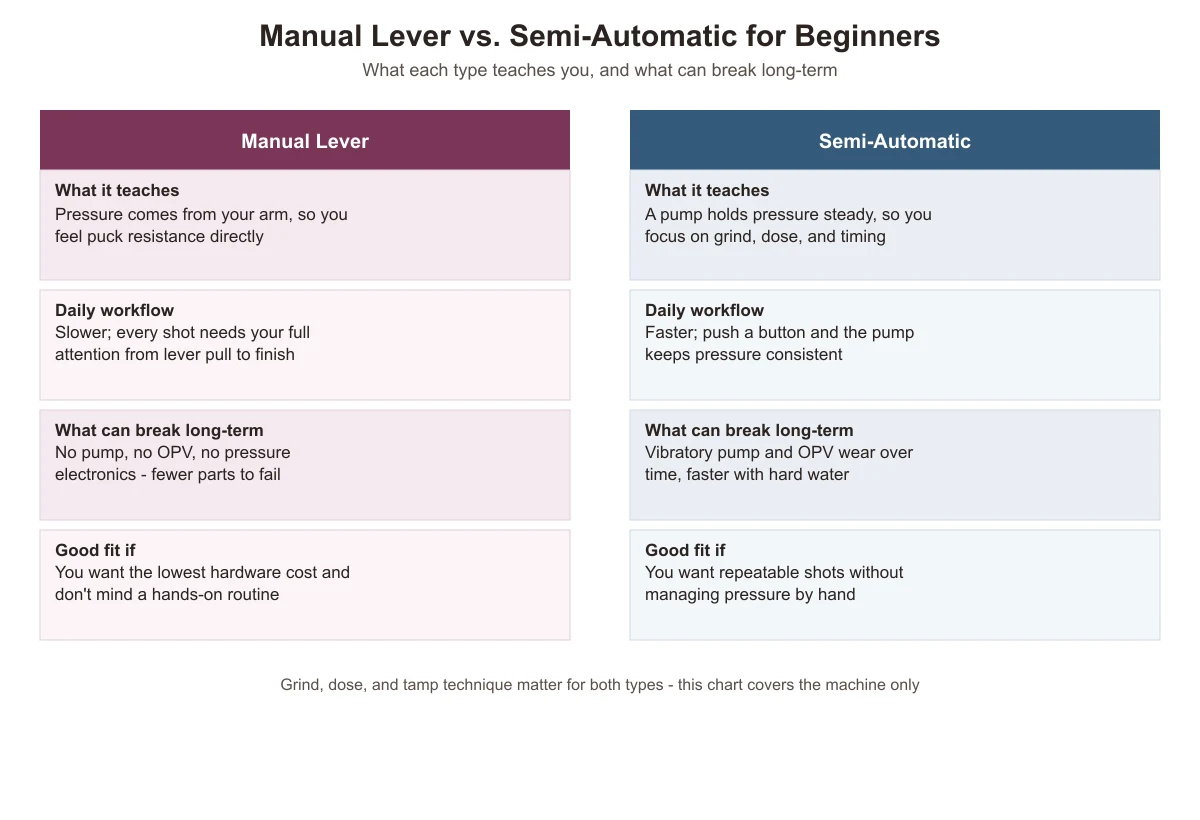
The graphic below summarizes the comparison. The table underneath holds the same information in text.
| Manual Lever | Semi-Automatic | |
|---|---|---|
| What it teaches | Direct puck resistance and feel, since pressure comes from your arm | Grind, dose, and timing, since a pump holds pressure steady |
| Daily workflow | Slower; needs your full attention through the pull | Faster; pump holds pressure while you handle other steps |
| What can break long-term | No pump, OPV, or pressure electronics to fail | Pump and OPV wear over time, faster with hard water |
| Good fit if | You want the lowest long-term maintenance and don’t mind a hands-on routine | You want repeatable pressure without managing it by hand |
Frequently asked questions
Is a manual lever machine harder to use than a semi-automatic?
It takes more practice to pull a consistent shot, since pressure depends entirely on your arm instead of a pump. Most people need more attempts to get comfortable with a lever machine than with a semi-automatic, but neither requires prior experience to start learning.
Does a lever machine really need less maintenance than a semi-automatic?
It has fewer parts that can fail — no pump, no OPV, no pressure electronics — so there’s less that can wear out from age or hard water specifically in the pressure system. It still needs normal boiler, seal, and gasket upkeep like any espresso machine.
Can a beginner make good espresso on a manual lever machine right away?
Not usually on the first few attempts. Shot quality on a lever machine depends on consistent, practiced lever technique in addition to grind and dose, so there’s a learning curve specific to the lever itself that a pump-driven machine doesn’t have.
Will a semi-automatic’s pump eventually need to be replaced?
Possibly, depending on use and water quality. Published repair-technician guidance cites a typical vibratory pump service life of roughly 500 to 1,000 hours, shorter in hard-water areas where scale builds up inside the pump over time.
Sources
- La Pavoni, Professional Lusso product page — lapavoni.com
- Breville official instruction manual, Barista Express BES870 — breville.com
- Grindset.cafe, repair-technician explanation of pump, OPV, and gasket wear — grindset.cafe
espressomachinesforhome.com Editorial Team. Last updated: November 13, 2026.