A home espresso machine costs more to buy but less per cup over time; a pod machine costs less to buy and more per cup. As official list prices, the Breville Bambino espresso machine runs $299.95 and the Nespresso Essenza Mini runs $189.99 — a $109.96 difference. Ground coffee for home brewing averages about $0.37 per cup from national pricing data. Nespresso’s own per-capsule price could not be confirmed directly on this pass, so use the worked formula below with the price shown on nespresso.com today to find your own breakeven point.
Key takeaways
- The Breville Bambino ($299.95) costs $109.96 more upfront than the Nespresso Essenza Mini ($189.99), both current official list prices.
- Ground roast coffee averaged $9.32 per pound nationally in July 2026 (a government statistical series, not espresso-specific), which works out to roughly $0.37 per 18-gram double shot.
- Nespresso’s current per-capsule price wasn’t confirmed from a live fetch of its order pages during this research pass — check nespresso.com directly and plug that number into the formula below.
- Pod machines win on convenience, consistency, and counter simplicity; espresso machines win on cost per cup once you drink enough volume to clear the machine price gap.
- Your own breakeven point depends entirely on your actual pod price and how many cups you drink a day — there’s no single right answer, only your own math.
Espresso machine vs Nespresso: what’s the real price difference?
Comparing official list prices for one machine from each category: the Breville Bambino, a compact home espresso machine, is $299.95 direct from Breville. The Nespresso Essenza Mini, a basic pod machine, is $189.99 direct from Nespresso. That’s a $109.96 gap in favor of the pod machine at purchase time. Neither price includes a grinder; the Bambino doesn’t come with one built in, so a full espresso setup using fresh-ground beans typically means a separate purchase, while a pod machine needs nothing extra to make a cup.
How much does a cup of home-brewed espresso cost in beans?
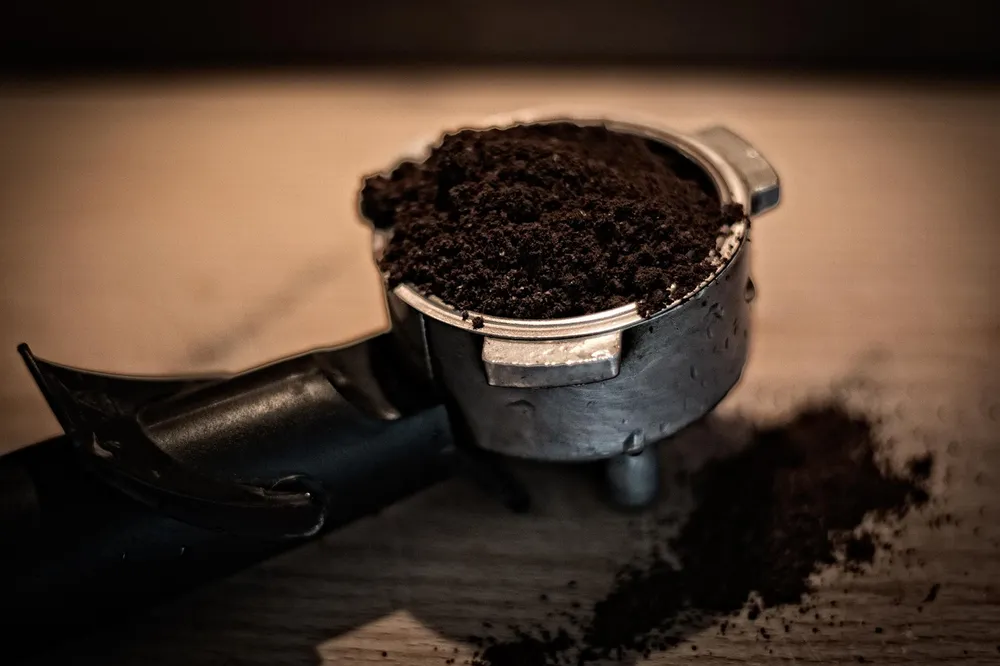
According to Federal Reserve Economic Data (FRED series APU0000717311, sourced from Bureau of Labor Statistics CPI data), the average U.S. retail price for ground roast coffee reached $9.32 per pound in July 2026. That figure is a national average for ground coffee generally, not an espresso-specific blend, so treat it as a reasonable baseline rather than an exact price for any one bag. At $9.32 per pound (453.6 grams), that works out to about $0.0205 per gram. A typical double-shot dose of roughly 18 grams of ground coffee costs about $0.37 in beans alone — before accounting for the water, electricity, or any grinder involved.
How much does a Nespresso pod cost?

This is the number we can’t give you as a verified fact. Nespresso’s capsule order pages are JavaScript-rendered and did not return pricing on a direct fetch during this research pass, so rather than repeat an unconfirmed number as if it were current, here’s what we can tell you: go to nespresso.com’s Original-line order page, check the price shown for a sleeve of 10 capsules in the variety you’d actually drink, and divide by 10 to get your per-cup pod cost. Prices vary by roast and promotion, so the number you see today is the one to use, not a figure from an article written on a different date.
How do you calculate your own breakeven point?
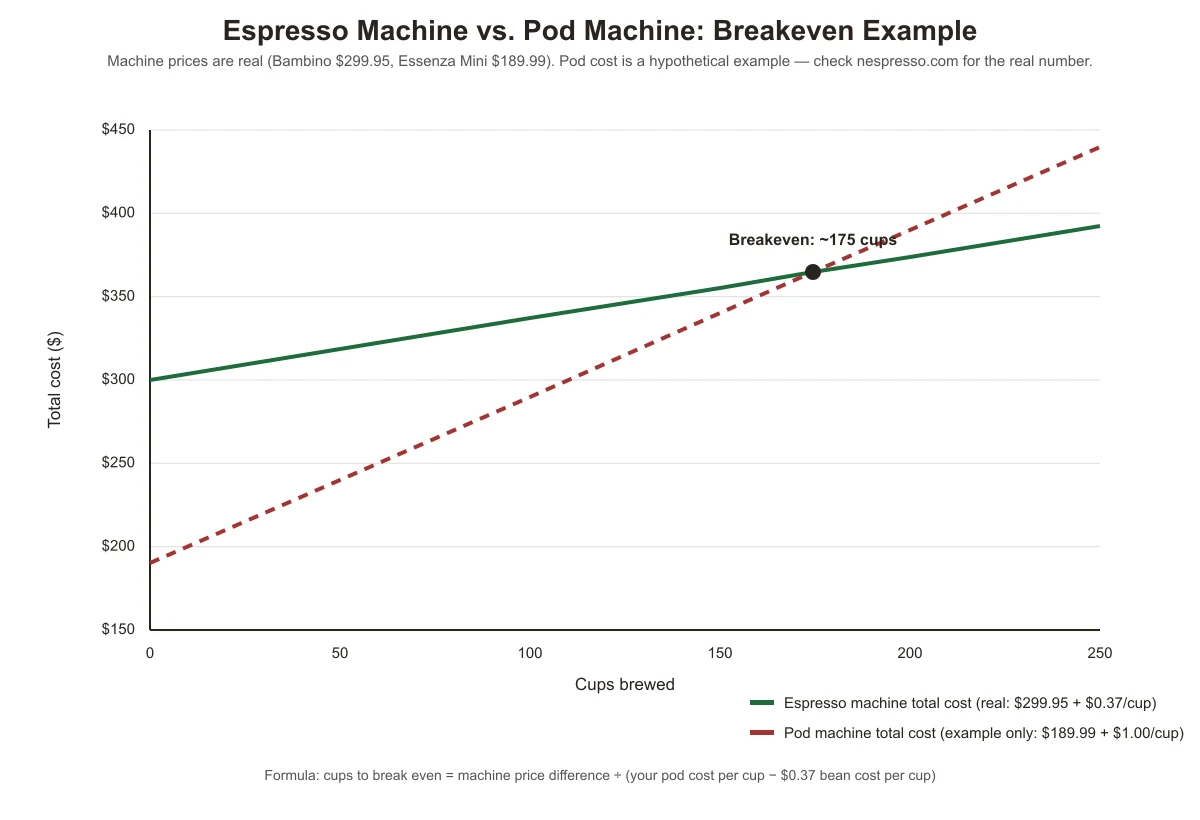
The formula is simple once you have your own numbers: divide the machine price difference by how much you save per cup by brewing instead of using a pod.
Cups to break even = Machine price difference ÷ (your pod cost per cup − $0.37 bean cost per cup)
Worked example using a hypothetical pod price of $1.00 per cup (not a quoted Nespresso price — substitute your own): your savings per cup would be $1.00 − $0.37 = $0.63. Dividing the $109.96 machine price gap by $0.63 gives roughly 175 cups to break even. At one cup a day, that’s about six months; at two cups a day, about three months. Redo this math with the actual pod price you find on nespresso.com and your own daily cup count — the formula stays the same, only the inputs change.
What about size and cleanup?
A pod machine is generally simpler to live with day to day: no portafilter to clean, no puck to knock out, and no beans to manage, just a used capsule to eject into a bin. An espresso machine asks more of you — cleaning the portafilter and basket after every shot, periodic backflushing, and descaling on a schedule matched to your water hardness (see our descaling schedule guide). If counter space is tight, that’s a separate question worth checking against actual machine footprints; see our counter space guide for how much room different machine types need.
Which should you buy?
If you drink coffee occasionally, value simplicity over cost-per-cup, or don’t want to deal with cleaning a portafilter, a pod machine’s lower upfront cost and near-zero learning curve is a reasonable trade. If you drink espresso daily, don’t mind the extra cleanup, and want the lowest long-run cost per cup, a home espresso machine closes its price gap within months for most regular drinkers. If you’re still deciding what kind of machine fits your routine at all, our home espresso machine buying guide and our semi-automatic vs. super-automatic comparison cover the decision in more depth.
Cost and cleanup comparison at a glance
| Breville Bambino (espresso machine) | Nespresso Essenza Mini (pod machine) | |
|---|---|---|
| Official list price | $299.95 | $189.99 |
| Price difference | $109.96 more for the espresso machine | |
| Cost per cup (beans/pods) | ~$0.37 (national average ground coffee price) | No data confirmed — check nespresso.com directly |
| Needs a separate grinder? | Yes, for fresh-ground coffee (not included) | No |
| Daily cleanup | Portafilter and basket rinse each use; periodic backflush and descale | Eject used capsule; descale periodically |
Frequently asked questions
Does this math include the cost of a grinder?
No. The Bambino’s $299.95 price is for the machine alone; it doesn’t include a grinder, and most people brewing fresh-ground espresso eventually add one. This comparison uses bean cost only to keep the formula simple — add your actual grinder cost to the machine price difference if you’re starting from zero.
Is Nespresso’s pod price always more expensive per cup than ground coffee?
No data from us on an exact figure — nespresso.com’s live capsule pricing didn’t return on a direct fetch during this research pass, and we’d rather tell you that than guess. Check the current price for your preferred capsule on nespresso.com, divide by 10 for the per-capsule cost, and run it through the breakeven formula above against the roughly $0.37-per-cup bean cost to see where you land.
Does the comparison change with a more expensive espresso machine?
Yes. A pricier machine simply widens the gap you need to close with per-cup savings, which means more cups, and more time, to reach breakeven. The formula above works the same way regardless of which specific machine you’re comparing — just substitute its price for the Bambino’s.
What if I don’t drink coffee every day?
Fewer cups per week means it takes longer in calendar time to reach the same breakeven cup count, even though the number of cups needed doesn’t change. If you only drink espresso occasionally, the pod machine’s lower upfront cost and simplicity may matter more to you than the long-run cost per cup.
Sources
- Nespresso: Essenza Mini official US listing — $189.99 list price
- Breville: Bambino official US product page — $299.95 list price
- FRED (Federal Reserve Economic Data), series APU0000717311 — average U.S. retail price for ground roast coffee, $9.32/lb, July 2026
espressomachinesforhome.com Editorial Team. Last updated: November 13, 2026.