Last updated: November 17, 2026
Quick answer: for a typical DeLonghi Magnifica Evo, the descale cycle takes about 15 minutes, plus two rinses, while the steam-wand Evo model takes about 45 minutes; for Cleaning, Descaling, and Maintenance Guide work, clean the parts that touch coffee often and descale when mineral scale builds up. Cleaning removes oils and residue, descaling removes mineral deposits, and both matter because one problem does not fix the other. For machine-specific steps, consult the manual or manufacturer support before starting.
Key takeaways
- Cleaning and descaling are not the same job, and using one as a substitute for the other leaves a gap.
- Daily and weekly care keeps residue from hardening into a bigger chore later.
- Descaling is a timed process on many machines; on a DeLonghi Magnifica Evo, Coffee Fix Hub says the cycle runs about 15 minutes, with two rinses after.
- Some models need different handling. Coffee Fix Hub says the steam-wand Evo model has a longer descaling cycle, about 45 minutes, and includes a step where you turn the steam dial.
- Ultrasonic cleaning uses ultrasound, usually from 20 to 400 kHz, according to Wikipedia, but it is not a magic fix for neglected maintenance.
What cleaning does and what descaling does
Cleaning removes coffee oils, milk residue, and loose grime; descaling removes mineral scale inside the water path. That difference is the whole guide in one line, because many problems people call “dirty” are really two separate issues.
A generic article often blurs those jobs together. That leads to the wrong fix: scrubbing the outside of the machine when the water path is the real issue, or running a descale cycle when the basket, drip tray, or steam tip still have dried residue. The result is usually a machine that looks cleaner but still tastes off, runs slowly, or behaves inconsistently.
Here is the practical split:
| Criteria | Cleaning | Descaling | Winner for |
|---|---|---|---|
| What it removes | Coffee oils, milk residue, grime | Mineral scale from water | The problem you actually have |
| Where it acts | Surfaces and removable parts | Internal water path | Internal flow issues |
| Usual trigger | Visible mess, odor, sticky residue | Signs of scale or a descale prompt | The correct symptom |
| Main risk if skipped | Stale taste, blocked parts, hygiene issues | Flow problems, heating issues, extra strain | Long-term reliability |
| Time pattern | Often more frequent | Less frequent, but still routine | Busy users who want less work later |
| Mistake to avoid | Wiping only the shell and ignoring contact parts | Descaling without cleaning first | People trying to save time |
| Best fit | Everyday upkeep | Water hardness and mineral buildup | Owners with mixed water quality |
| What it does not fix | Internal scale | Coffee residue on baskets or trays | When the diagnosis is wrong |
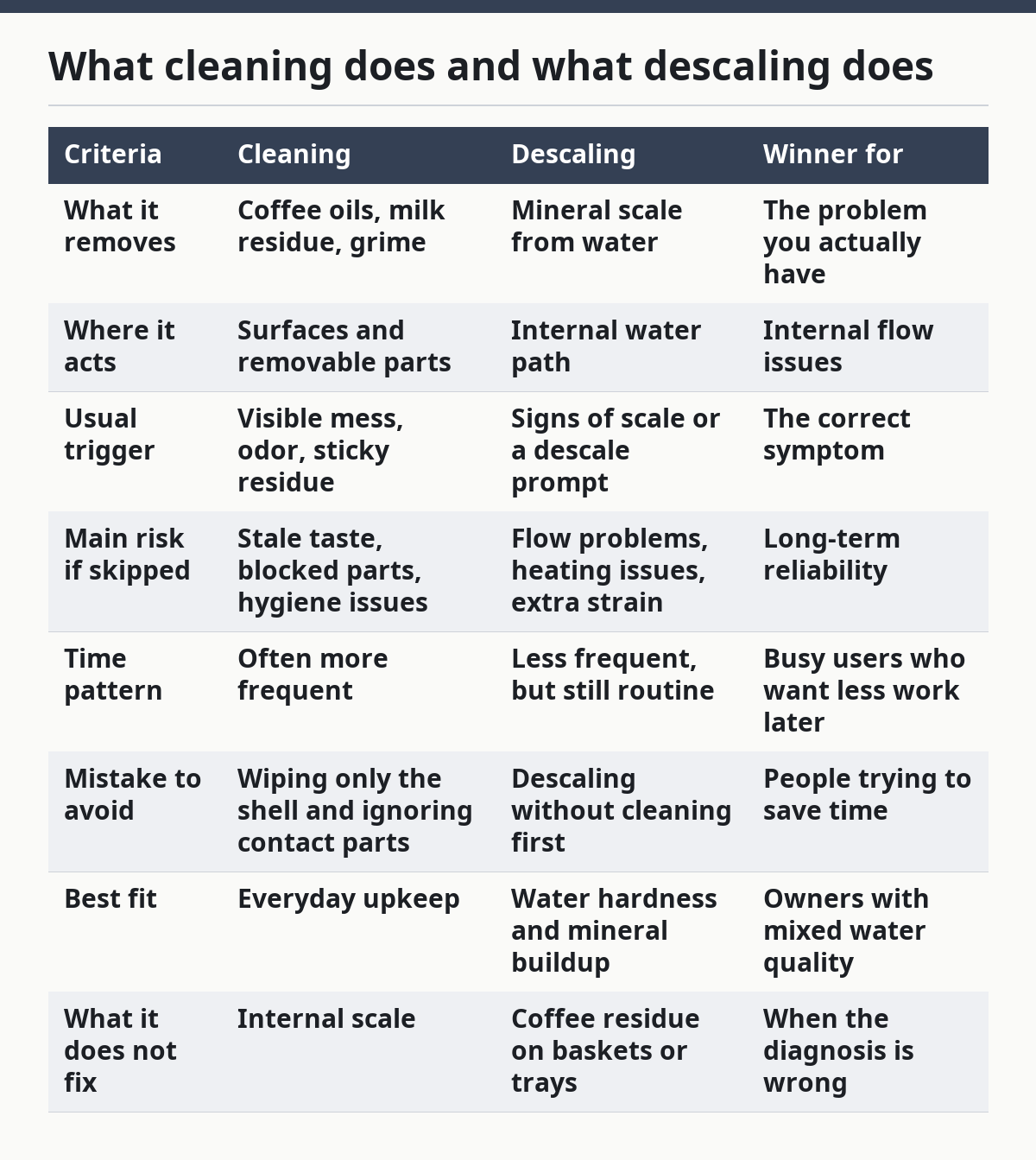
Therefore, cleaning wins when the issue is taste, smell, or residue on parts you can reach. Descaling wins when the issue is mineral buildup inside the water system. If the machine has both problems, cleaning first and descaling second is usually the safer order, but consult the machine manual or a qualified technician if the model has special instructions, because scale and residue each need their own treatment.
However, this is where many guides go wrong: they treat maintenance like a single button. A machine can be spotless on the outside and still clogged inside, or scaled inside and still sticky on the outside. The right answer depends on what the symptom points to, so a professional check is sensible if the diagnosis is unclear.
How should regular cleaning work?
Regular cleaning should be simple, frequent, and focused on the parts that touch coffee and milk. If the surface is wiped but the contact parts are left alone, taste drops before the machine looks dirty.
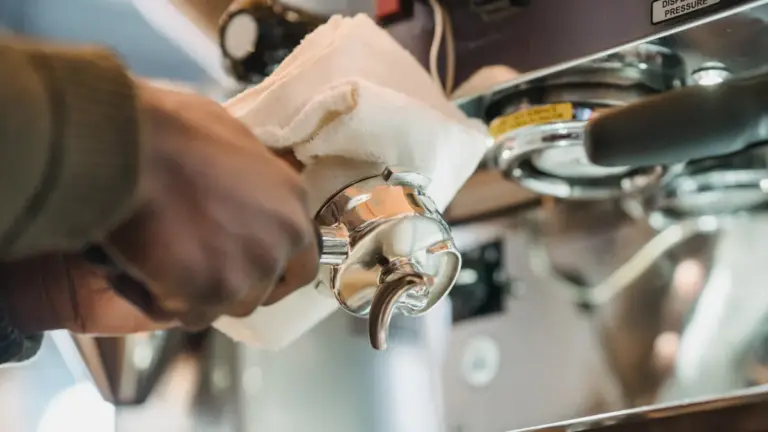
For a home espresso setup, the useful rule is to clean after use, then deeper-clean on a repeating schedule that fits how often the machine runs. That means removing loose grounds, emptying wet waste before it dries, and keeping milk residue from setting on steam parts. It also means not letting the drip tray, baskets, and spouts become a hardened crust.
The point is not perfection. The point is to stop residue from turning into a repair problem. Coffee oils go stale. Milk residue hardens fast. Grounds can stick in places that are easy to ignore until they start changing flavor or restricting flow.
A practical cleaning routine has three layers. First is the quick reset after use: clear the obvious mess, rinse what can be rinsed, and leave nothing damp that will harden. Second is the deeper weekly clean: pay attention to the parts that touch water, coffee, and milk. Third is the check for hidden buildup: if anything smells off, flows slowly, or leaves residue in the cup, look beyond the visible surfaces.
The biggest mistake is waiting for a taste problem before cleaning. By that point, residue has usually spread into places that take longer to fix. Another mistake is overcleaning the wrong area and neglecting the parts that matter most. A shiny case does not brew better coffee.
If you want a simple test, use this rule: anything that contacts coffee, hot water, or milk deserves more attention than the outer shell. That includes baskets, trays, spouts, and steam-related parts. The case can be wiped in seconds. The contact parts determine flavor.
When is descaling the right move?
Descaling is the right move when mineral deposits are affecting the water path, flow, or heating behavior. It is not about surface grime, and it is not a substitute for cleaning residue off the parts you handle every day.
A descaling cycle is a machine’s way of moving descaler through the system so scale can loosen and rinse out. On a DeLonghi Magnifica Evo, Coffee Fix Hub says to put descaler in the tank to level A, add water to level B, and hold the descale button for at least 5 seconds. That is a good example of why descaling is not guesswork: the sequence matters.
Coffee Fix Hub also says the descaling cycle on that model runs about 15 minutes and is followed by two rinses. That detail matters because descaling is not finished when the cleaning solution has gone through once. Rinsing clears the system after the treatment, which is the part many impatient owners are tempted to rush, though you should still consult the manual if your machine has a different rinse sequence.
The steam-wand Evo model is different. Coffee Fix Hub says its descaling cycle is about 45 minutes and includes a step where you turn the steam dial. That is a real reminder that “same brand” does not mean “same process.” Model variation changes the job.
Descaling is also the area where skipping instructions causes the most regret. If the tank levels are wrong, the cycle can be interrupted or ineffective. If the rinses are skipped, the system may still carry leftover solution. If the container under the spouts is too small, the mess becomes part of the maintenance job.
Use a container of at least 2 litres under the coffee and hot water spouts, according to Coffee Fix Hub. That is not a nice extra. It is the practical difference between a controlled cycle and a spill all over the counter.
How do I descale without making a mess?
The safest approach is usually to follow the machine’s tank marks, allow the cycle to finish, and catch the runoff with a large container, but check the manual if the model has special steps. The steps are simple, but the order matters more than people think.
On the DeLonghi Magnifica Evo, Coffee Fix Hub says to pour descaler up to level A, marked on the back of the tank, then add water to level B. After that, hold the descale button for at least 5 seconds. That sequence is the core of the process on that model, and it shows why reading the markings before you start matters.
The same source says to place a container of at least 2 litres under the coffee and hot water spouts. That part saves the counter and gives the cycle somewhere to go. If the container is too small, you risk stopping mid-cycle just to empty it, which is exactly the kind of interruption that makes maintenance feel longer than it is.
The cycle itself takes time. Coffee Fix Hub says the standard descaling cycle runs about 15 minutes and ends with two rinses. The steam-wand Evo model takes about 45 minutes and includes turning the steam dial, so it is not wise to assume one model’s steps apply to another.
A good descale should be uneventful in the best way. It is measured, contained, and finished all the way through. A bad descale is the opposite: half-read instructions, guessed amounts, and a rinse that never happened because the user assumed the cycle was “done enough.”
Here is the cleanest way to think about it: follow the tank marks, start the cycle, watch the runoff, and let the rinses finish. Do not improvise the levels. Do not shorten the rinse. Do not swap one model’s directions for another model’s directions just because the name on the front is similar.
Cleaning versus descaling: which one matters more?
Neither wins every time; cleaning matters more for daily taste and hygiene, while descaling matters more for flow and long-term water-path health. If you only do one, the machine usually tells on you in different ways.
The right choice depends on the symptom. Bitter or stale flavor often points to residue. Slow flow, a scale warning, or an internal buildup problem points more toward descaling. A machine can need both at once, and that is common enough that it should be treated as normal maintenance, not a special failure.
Cleaning is more visible, so people notice it first. Descaling is less visible, so people put it off longer. That is backwards. Scale can sit inside the machine while the exterior looks fine. The reader who wants a reliable home setup should treat both jobs as part of one system.
The honest trade-off is time. Cleaning is usually shorter and more frequent. Descaling is less frequent but more structured and easier to mess up if the machine’s instructions are ignored. If the goal is the least trouble over time, both jobs need to happen on schedule.
This is why the “which matters more?” question has a real answer: cleaning matters more if the problem is right in front of you, and descaling matters more if the problem is inside the water path. If the machine is due for both, do not choose. Do the two jobs in the right order.
Where does ultrasonic cleaning fit?
Ultrasonic cleaning can help with certain removable parts, but it is not a replacement for normal cleaning or descaling. It is a tool, not a cure-all.
Ultrasonic cleaning uses ultrasound, usually from 20 to 400 kHz, according to Wikipedia. That means the method relies on sound waves in liquid rather than on scrubbing alone. It can be useful for awkward removable parts, but it is not a substitute for routine upkeep.
The limitation is just as important. Ultrasonic cleaning does not remove the need to clean obvious residue from contact parts, and it does not remove mineral scale from the water system the way a proper descale cycle does. If the machine has coffee buildup and scale at the same time, ultrasonic cleaning only addresses part of the picture.
That makes it useful in a narrow but real way. It can be a good fit for removable parts that are awkward to clean by hand, especially when residue clings in small corners. It is a poor fit as a replacement for a descale cycle, because scale lives in a different place and needs a different method.
The mistake to avoid is turning a niche tool into a maintenance philosophy. The machine still needs routine cleaning. It still needs descaling when mineral buildup calls for it. Ultrasonic cleaning, even at 20 to 400 kHz, is an extra method, not the main plan.
What should I do if I want the simplest maintenance routine?
The simplest routine is to clean often, descale when the machine asks for it or when scale is evident, and never let residue sit long enough to harden. That is the lowest-friction plan for most home users.
A simple routine works because it divides the work into small jobs. Quick cleaning keeps the visible parts under control. Descaling handles the inside of the system. Neither task has to become a weekend project if it is not ignored for too long.
The most useful habit is to separate “wiping” from “maintenance.” Wiping is what you do after use. Maintenance is the deeper work that keeps the system functioning. If those two get lumped together, one of them gets skipped.
The second useful habit is to treat the machine’s model-specific instructions as the rulebook. Coffee Fix Hub’s examples show that a DeLonghi Magnifica Evo and a steam-wand Evo model do not follow the same timing or steps. That means a generic shortcut can be wrong even when it sounds reasonable.
A good routine should feel repetitive, not dramatic. If every cleaning session feels like a rescue operation, the schedule has already slipped. If every descale requires guessing, the instructions are not being followed closely enough. The goal is boring consistency.
Which maintenance mistakes cause the most trouble?
The biggest mistakes are mixing up cleaning and descaling, skipping rinses, using the wrong setup for the cycle, and waiting for a problem to become obvious. Those mistakes cause more frustration than any one hard-to-reach spot on the machine.
The first mistake is treating surface cleaning as if it solves scale. It does not. Scale sits in the water path, so wiping the case cannot fix it.
The second mistake is treating a descale cycle like a rinse and forgetting the rinse itself. Coffee Fix Hub says the Magnifica Evo cycle ends with two rinses, which is a reminder that the treatment and the cleanup after it are both part of the process.
The third mistake is using the wrong container. Coffee Fix Hub says to use a container of at least 2 litres under the coffee and hot water spouts. A smaller container turns a controlled cycle into a spill risk.
The fourth mistake is assuming all versions behave alike. Coffee Fix Hub notes that the steam-wand Evo model has a longer cycle, about 45 minutes, and a steam-dial step. A person who skips those model differences is likely to interrupt the cycle or leave it unfinished.
The practical fix is straightforward: know which problem you are solving, read the steps for that model, and finish the rinse. That sounds basic because it is basic. Most maintenance failures come from rushing, not from complexity.
When should I stop improvising and check the manual?
You should stop improvising as soon as the machine’s steps depend on tank marks, a button hold, a timed cycle, or a model-specific dial move. That is the line between ordinary cleaning and a process that can go wrong if guessed.
Coffee Fix Hub’s descale example makes that clear. The tank uses level A for descaler and level B for water, the descale button must be held for at least 5 seconds, and the cycle timing depends on the model. That is not the kind of task that improves with guessing.
If a process has a container requirement, a timed cycle, and a follow-up rinse, then the instructions are part of the tool. Skipping them is not a shortcut. It is a way to make the machine behave unpredictably or leave the job half done.
This is also where maintenance gets easier, not harder, when the steps are respected. Clear instructions reduce uncertainty. Uncertainty is what makes people delay the job. Delay is what turns maintenance into repair.
The short version is simple: if the machine gives you marks, buttons, a timer, or a dial step, follow those details exactly. That is especially true for descaling, where the process is meant to move through the system in a specific order.
What is the bottom line for a home espresso machine?
The bottom line is to keep surface cleaning frequent, keep descaling model-correct, and stop treating maintenance like one single task. Clean the outside and the contact parts often. Descale the inside on the machine’s terms.
For a home setup, that means paying attention to the parts that touch coffee and milk, and paying equal attention to the parts that move water. If the machine is making taste worse, clean first. If the water path is scaled, descale with the right cycle. If both are true, do both.
That is the real complete guide: not a single miracle fix, but a clear split between jobs. Cleaning handles residue. Descaling handles mineral buildup. Maintenance keeps both from becoming a bigger problem than they need to be.
FAQ
How often should I clean my espresso machine?
You should clean the parts that touch coffee and milk often enough that residue never gets a chance to harden. That usually means after use for the quick jobs, then a deeper clean on a repeating schedule that fits how much the machine is used. The exact rhythm depends on use, but the goal is always the same: do not let oils and milk residue sit.
How do I know if I need descaling instead of cleaning?
You need descaling when the issue points to mineral buildup inside the water path, not just dirt on the surface. If the problem is flow, internal buildup, or a descale prompt, cleaning alone will not solve it. If the problem is sticky residue, odor, or visible grime, cleaning comes first.
How long does a descale cycle take?
On a DeLonghi Magnifica Evo, Coffee Fix Hub says the descaling cycle runs about 15 minutes and is followed by two rinses. The steam-wand Evo model is different and takes about 45 minutes, with a step where you turn the steam dial. That is why the model matters.
What size container do I need for descaling?
Coffee Fix Hub says to use a container of at least 2 litres under the coffee and hot water spouts. That size helps catch the runoff during the cycle and keeps the process under control. A smaller container can turn the job into a spill cleanup.
Can ultrasonic cleaning replace regular maintenance?
No, ultrasonic cleaning cannot replace regular cleaning or descaling. According to Wikipedia, ultrasonic cleaning uses ultrasound, usually from 20 to 400 kHz, which makes it a useful tool for certain parts. It still does not remove the need for routine cleaning or the separate job of descaling.
Sources
- Wikipedia, Cleaning – Wikipedia (checked 17 Nov 2026)
- Coffee Fix Hub, How to Descale a DeLonghi Magnifica Evo: Step by Step – CoffeeFixHub (checked 17 Nov 2026)
Drafted with AI; not yet reviewed by a person.