Last updated: November 17, 2026
Quick answer: for How Much to Budget for a Complete Home Espresso Setup: Hidden Costs and Necessary Gear, start with a 60/40 split and plan roughly 40 percent of the total budget for the grinder, with the rest for the brewer, tools, water treatment, and upkeep. A complete home espresso setup usually needs more than the espresso maker itself, because the grinder, water treatment, and small tools can matter as much as the main unit. For your own situation, consult a qualified professional if you are unsure how to balance the budget. This is a practical starting point, not financial advice.
Key takeaways
- The hidden costs are not hidden once you list them: grinder, scale, WDT tool, knock box, filtration pitcher, water treatment, and upkeep.
- The grinder usually deserves the largest share of the budget after the main brewer, because 60/40 is a better starting split than buying a fancy brewer with a weak grinder.
- A “complete” setup does not mean expensive; it means the parts work together and the water, dosing, and cleanup are covered.
- Ongoing costs matter. Filters, cleaning supplies, and replacement parts can change the real budget over time.
- The wrong place to save is usually the grinder and the water side, not the tray, tamper, or box on the counter.
What counts as a complete setup?
A complete home espresso setup means the brewer, the grinder, and the small tools needed to make consistent shots are all in place. At minimum, that includes an espresso maker, a grinder built for fine adjustment, a precision scale, a WDT tool, and some way to manage used pucks with a knock box.
The hidden cost is that each of those pieces solves a different problem. The scale controls dose, the grinder controls particle size, the WDT tool breaks up clumps in the basket, and the knock box keeps cleanup from turning into a daily mess. If any of those are missing, the setup still works, but it works with more waste, more guesswork, and more frustration.
Because water chemistry also affects espresso, the water side is easy to overlook. A filtration pitcher or another treatment method may be needed depending on your tap water, so consult local water guidance or a qualified professional if you are unsure. Espresso is sensitive to mineral balance and scale buildup. For water quality basics, the U.S. Environmental Protection Agency has plain-language guidance on drinking water, and the Specialty Coffee Association publishes brewing water guidance for coffee; both are useful references even if the exact choice depends on your location and water supply.
If the budget only covers one strong piece and a long list of weak extras, the setup is not really complete. It is a counter full of compromises.
How should the budget be split?
The budget should be split so the grinder does not get squeezed by the brewer. The 60/40 rule is the cleanest shorthand: about 40 percent for the grinder and the rest for the machine, accessories, and setup costs.
That rule matters because espresso exposes weak links fast. A good brewer with a poor grinder gives uneven results, and the shot can taste thin, harsh, or both. A better grinder does not fix every problem, but it gives the brew side a fair chance.
Here is a practical way to think about the split without pretending one number fits every home:
| Budget path | Who it is for | What it buys | What to skip |
|---|---|---|---|
| Grinder-first split | The reader who wants better espresso from the start | More money goes to grind quality, a usable machine, and basic tools | Fancy tampers, decorative extras, and gadgets that do not improve extraction |
| Balanced split | The reader who wants a full setup with fewer weak spots | A decent brewer, a grinder that can handle espresso, and core accessories | Overspending on the brewer while leaving water and dosing alone |
| Tight-budget split | The reader who needs the lowest workable entry point | A functional brewer, a serviceable grinder, a scale, and cleanup tools | Add-ons that do not change shot quality right away |
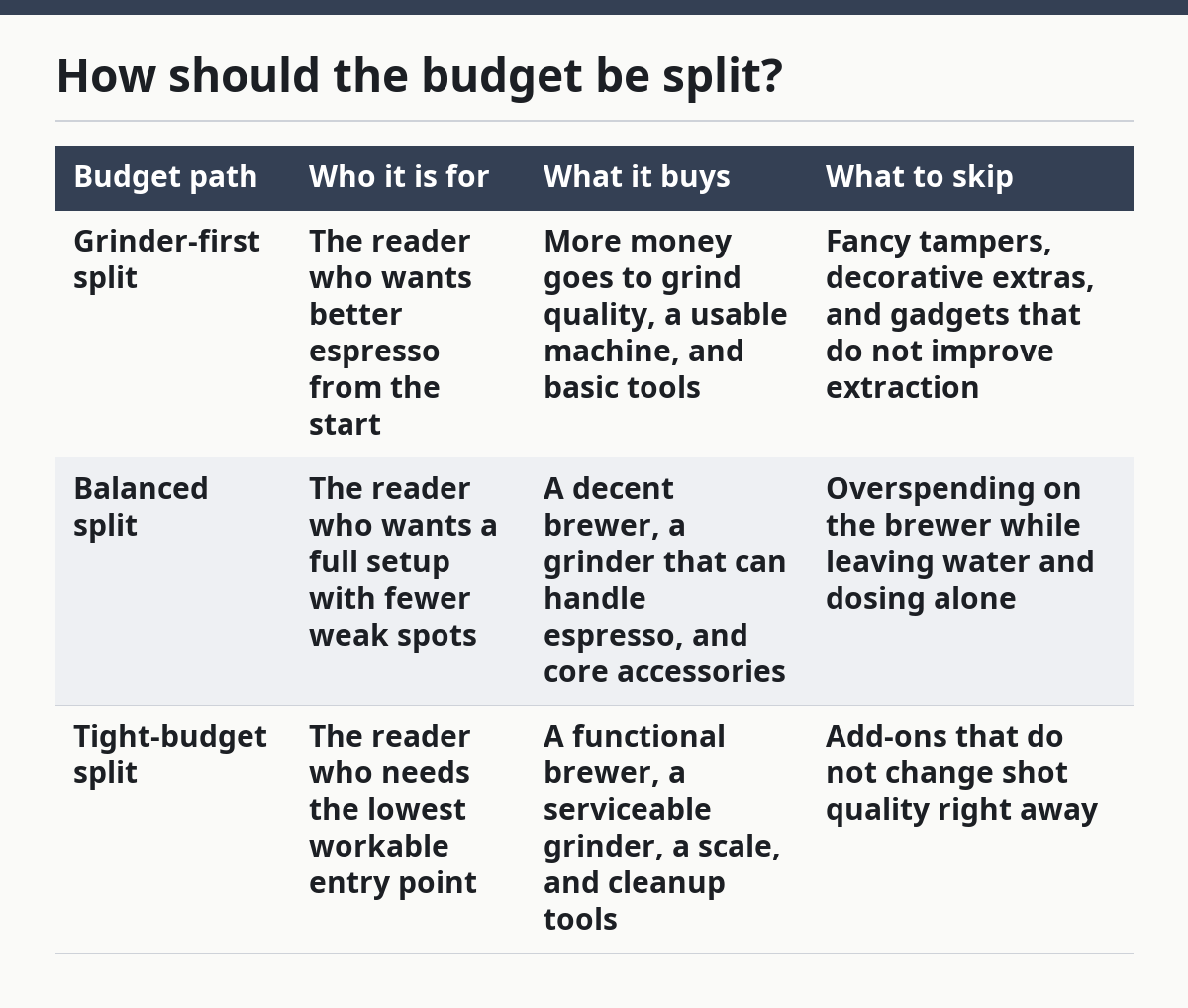
The 60/40 split is not a law. It is a warning against the common mistake of putting too much money into the brewer and too little into grind quality. If the grinder is underfunded, the rest of the setup carries more baggage than it should.
What gear is necessary?
The necessary gear is the short list that makes repeatable espresso possible: the brewer, the grinder, a precision scale, a WDT tool, a knock box, and a way to manage water. A filtration pitcher often belongs on that list because water treatment is part of the brewing system, not a side note.
A precision scale is the easiest place to remove guesswork. It helps measure dose and beverage weight, which makes it easier to spot when a shot is running off target. A WDT tool is a thin stirring tool used to break clumps in the basket before tamping; it is simple, but it can reduce channeling, which is when water finds a weak path through the coffee bed.
The knock box is not glamorous, but it keeps spent pucks from ending up in the sink or trash in messy clumps. The filtration pitcher matters when tap water needs softening or cleaning up before use. If the water is already suitable, the pitcher may be less urgent, but the budget should still leave room for some treatment method if testing or local guidance points that way; consult a qualified professional if the local water situation is unclear.
A lot of generic advice skips these items because they are not shiny. That is a mistake. A setup that lacks the small tools often ends up costing more in wasted coffee than the tools would have cost to add.
Where do hidden costs show up?
Hidden costs show up in the parts that are easy to forget on day one. The first is maintenance supplies: backflush detergent if the brewer needs it, descaling or cleaning products if the manufacturer calls for them, and replacement gaskets or filters over time. Those are not optional forever, even if they are easy to ignore at the start.
The second hidden cost is water management. A filtration pitcher has a purchase cost and an ongoing filter cost. If the water in the area is hard, the budget may also need space for more frequent cleaning. If the water is already well suited, the budget can shift toward better beans or a stronger grinder instead.
The third hidden cost is workflow. A setup that looks complete on paper can still feel incomplete if the counter has no room for the brewer, grinder, scale, and knock box. That is not a money line on a receipt, but it is still a cost because cramped gear gets used less often.
A good budget includes a small reserve for replacement and upkeep. That reserve does not need a heroic number attached to it to be useful. It just needs to exist, because an espresso setup is a system, not a one-time buy.
What should you skip first?
You should skip cosmetic extras first, because they add cost without improving the shot. Fancy tampers, matching wooden handles, decorative trays, and display pieces are the easiest things to delay.
The next items to skip are duplicates of the same job. A second pitcher, a second scale, or a pile of baskets can eat budget without fixing the real weak point. One good grinder and one honest scale matter more than a drawer full of accessories.
If the budget is still tight, skip the brewer upgrade before you skip the grinder upgrade. That sounds backward to some buyers, but it follows the 60/40 rule. A modest brewer with a good grinder usually gives a better starting point than a strong brewer fed by a poor grinder.
Do not skip water treatment by default. If a filtration pitcher or another treatment method is needed for the local water, leaving it out can create scale, unstable flavor, and more maintenance. That is the kind of hidden cost that shows up after the receipt is already paid; consult a qualified professional or use local water guidance if you are unsure.
When is the standard budget wrong?
The standard budget is wrong when the reader already owns one of the big-ticket parts or has a special water situation. If the grinder is already in the kitchen, the 60/40 split changes immediately because the money should go to the brewer, scale, and water side instead.
It is also wrong when the home has very hard water, very limited counter space, or a need for faster cleanup. In those cases, the water budget and maintenance budget deserve more room than the average buyer expects. A filtration pitcher may stop being a “nice to have” and become a must-have, depending on the tap water.
The standard budget is also the wrong tool if the goal is not espresso quality but convenience alone. A person who only wants one button and a mild coffee habit may not need the same accessory list. This page is for the reader who wants real espresso at home and wants the costs laid out honestly.
What mistakes blow up the budget?
The first mistake is buying the brewer before the grinder is funded. That leaves the setup lopsided, because the grinder is what turns beans into an espresso-ready dose. The fix is to protect the grinder share first and treat the brewer as part of a system.
The second mistake is skipping the precision scale. Without it, dose and yield become guesses, and the budget gets wasted on bean after bean while the shot still drifts. The correct alternative is a simple scale that fits the workflow and stays on the counter.
The third mistake is ignoring the water side. If the water is not treated correctly, the setup can need more cleaning and can develop scale that shortens the useful life of the brewer. The alternative is to budget for a filtration pitcher or other treatment method up front.
The fourth mistake is treating accessories as fluff. A WDT tool and knock box are not luxury items if they reduce mess and improve puck prep. The correct approach is to buy only the accessories that solve a real problem and skip the rest.
The fifth mistake is forgetting ongoing cost. Cleaning supplies, filters, and replacement parts are part of ownership. If those are not planned for, the setup seems affordable only on the day it is bought.
How do I turn the budget into a buying order?
The buying order should start with the grinder, then the brewer, then the essentials that make the setup usable every day. That order follows the 60/40 logic and keeps the budget from being swallowed by one flashy item.
Start with the pieces that affect extraction directly: grinder, brewer, and precision scale. Then add the WDT tool, knock box, and filtration pitcher if the water or workflow calls for them. Finish with maintenance supplies so the setup can stay in service without surprise trips to the store.
A practical budget is not a single number. It is a plan that covers the main parts, leaves room for hidden costs, and does not pretend the support gear is optional. If the budget can do that, it is enough to build a complete home espresso setup without wasting money on the wrong layer of the stack.
For readers who want help choosing the brewer side of the system, the broader guide to how to choose a home espresso machine belongs on the next tab, while this page stays focused on budgeting and the hidden costs around it.
Drafted with AI; not yet reviewed by a person.