Last updated: November 20, 2026
Quick Answer: for Manual Lever vs Semi-Automatic Espresso Machines: Pressure Control and Repeatability, the semi-automatic is the better fit for most home users because it wins on repeatability, learning curve, error tolerance, and daily routine. If your goal is the same cup day after day, the semi-automatic usually wins; if your goal is to shape the shot by feel, a manual lever wins, but only if you accept more variability and more effort.
Key takeaways
- Lever machines reward a careful hand and punish sloppy timing; semi-automatics reward a stable routine.
- A spring lever naturally creates a declining pressure curve, while a pump-driven semi-automatic tends to hold a flatter delivery profile.
- A pressure gauge helps on both styles, but it matters more when you are trying to repeat a shot on purpose.
- The right choice depends on whether you want direct manual pressure profiling or a more predictable daily workflow.
- Neither style is ideal if you want push-button convenience with almost no learning curve.
What is the real difference between a lever and a semi-automatic?
Manual Lever vs Semi-Automatic Espresso Machines: Pressure Control and Repeatability comes down to one core split: a lever espresso machine gives you direct control over the shot’s pressure profile, while a semi-automatic gives you a pump that does the pushing for you. That difference changes more than the feel of the pull. It changes how pressure starts, how it falls, and how easy it is to make the same espresso twice.
A manual lever asks you to create the pressure curve with your hand or with a spring piston system. A semi-automatic usually relies on an electric pump, so the extraction is steadier and easier to repeat. In practice, that means the lever can be more expressive, while the semi-automatic is usually more consistent.
Therefore, the key question is not “Which is better?” It is “Do I want control or repetition?” If the answer is repetition, the pump wins. If the answer is control, the lever wins, but only if the user is willing to work for it.
The pressure side matters because espresso is not just hot water through coffee. The profile changes how the puck swells, how quickly the flow starts, and how the shot finishes. A declining pressure curve from a spring piston is part of the lever’s appeal, while a pump-driven profile is more uniform and easier to copy from shot to shot.
How does a lever espresso machine control pressure?
A lever espresso machine controls pressure either by the user’s arm or by a spring piston, and that is why it feels so different from a pump machine. The lever is the more hands-on tool, but that control comes with real trade-offs in consistency.
A direct lever lets the user shape pressure manually through the pull. That can be useful for pressure profiling because the shot does not have to follow one fixed rhythm. It also means the shot can drift if the pull changes from one attempt to the next. Small changes in force, timing, or puck resistance can change the result.
In contrast, a spring lever reduces some of that burden by using a spring piston to drive the shot. The spring creates a naturally declining pressure curve as the spring relaxes. That curve is one reason many lever fans value this style: the shot can start with more force and ease off in a way that feels intuitive and controlled, even though the pressure is still not as mechanically fixed as a pump profile.
The downside is just as important. A lever can be less forgiving of puck prep, basket fill, and tamp consistency. If the grind is off, the shot can move from too fast to too slow with little warning. For a user who wants a calm, repeatable weekday routine, that extra sensitivity can become a nuisance.
The Specialty Coffee Association’s brewing materials are a useful starting point for general espresso parameters, and the European Coffee Brewing Centre is another standards-minded reference point for brew consistency. The Specialty Coffee Association does not erase the fact that the lever still asks more from the person pulling it.
Why does a semi-automatic usually repeat shots better?
Because the pump is built to deliver pressure in a steadier, more controlled way, a semi-automatic usually repeats shots better. That does not make every shot identical, but it removes a big variable: the person on the handle.
With a semi-automatic, the main repeatability gains come from a fixed workflow. The pump starts the extraction in a more uniform way, and that makes it easier to compare one shot to the next. If the grind, dose, and puck prep stay close, the result is more likely to stay close too.
For example, this is why semi-automatics suit people who make espresso every morning and want fewer surprises. A pressure gauge is especially useful here because it gives a feedback loop when dialing in. You can see whether the extraction is behaving as expected without having to infer everything from the taste alone.
The limitation is that semi-automatic repeatability is not magic. A bad grind or sloppy distribution still ruins a shot. The pump only removes one source of variation. It does not fix the rest. If the appeal of espresso for you is shaping the pressure by hand and changing the flow in real time, a semi-automatic can feel a little sterile.
That said, the semi-automatic is the safer choice for most home users because the learning curve is gentler. It is also the better match for households where different people make coffee and nobody wants to memorize a lever routine. For the reader who wants fewer bad mornings, that matters more than romance.
Manual lever vs semi-automatic: side by side
The manual lever wins on tactile control, while the semi-automatic wins on repeatability and ease. Here is the direct comparison that matters for choosing one.
| Criteria | Manual lever | Semi-automatic | Winner for this condition |
|---|---|---|---|
| Pressure control | Direct manual shaping; spring levers add a natural decline | Pump-driven, more fixed delivery profile | Manual lever for users who want pressure profiling |
| Repeatability | Depends on the person pulling the shot | More stable from shot to shot | Semi-automatic for daily consistency |
| Learning curve | Steeper, because timing and force matter | Shorter, because the pump handles the push | Semi-automatic for beginners |
| Shot character | Can be more expressive and variable | Usually more uniform | Manual lever for experimentation |
| Error tolerance | Lower; the puck and pull both matter a lot | Higher; more forgiving of routine use | Semi-automatic for busy mornings |
| Pressure feedback | Often more dependent on feel and any pressure gauge present | Gauge data is easier to use for repeat dialing-in | Semi-automatic for measurable routine |
| Maintenance mindset | More attention to seals and lever feel, including piston seal wear | More attention to pump, valves, and routine cleaning | Semi-automatic for simpler day-to-day ownership |
| Best user | Hands-on espresso drinker who wants control | Home user who wants reliable output | Depends on the reader’s goal |
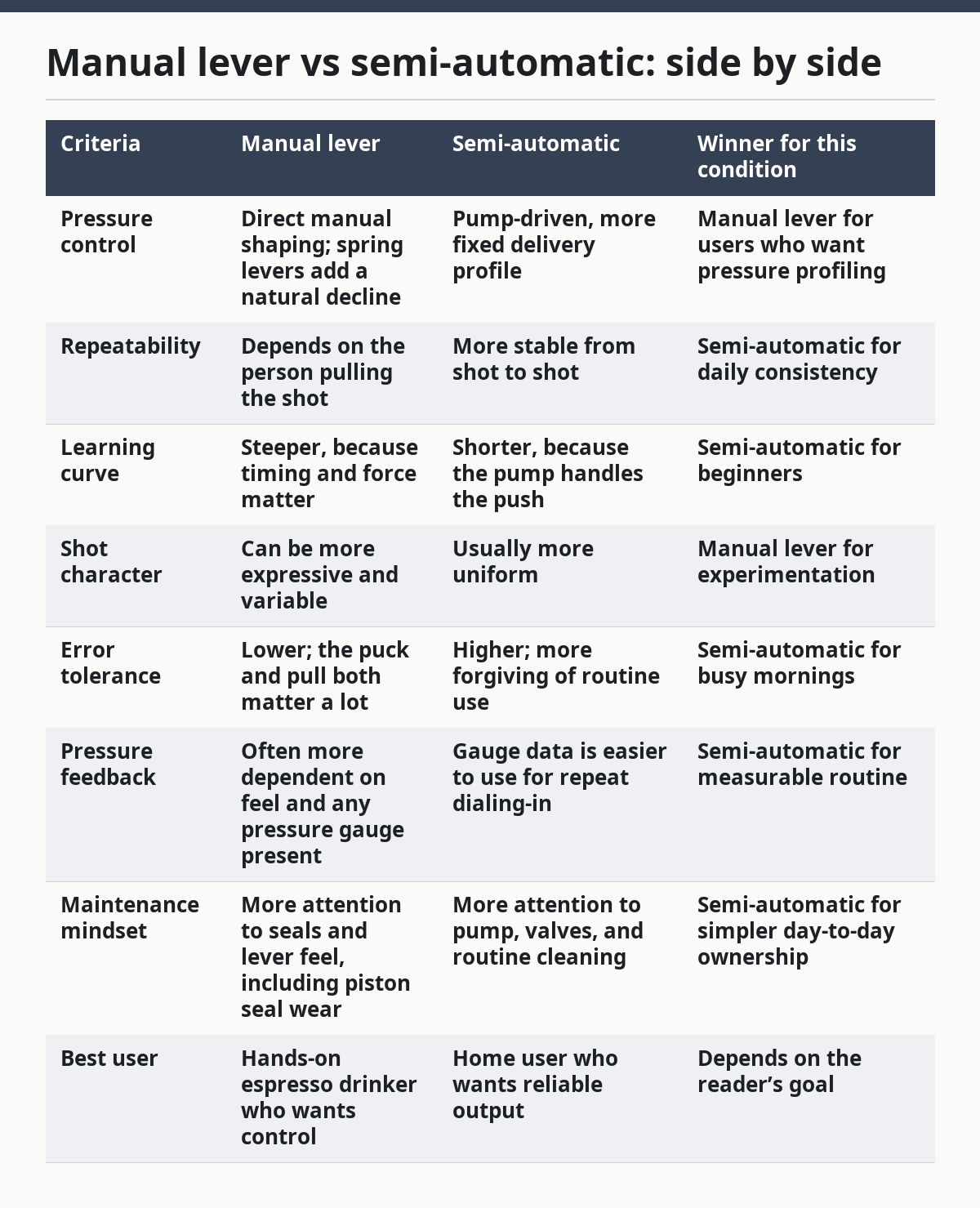
The table is blunt for a reason: these are not cosmetic differences. A lever changes how the shot is made. A semi-automatic changes how easily the shot can be repeated. If you want a machine that feels like a tool for craft, choose the lever. If you want a machine that behaves like a reliable kitchen appliance, choose the semi-automatic.
When does a lever actually make more sense?
A lever makes more sense when the reader cares more about shot shaping than about easy repetition. That is the clearest use case, and it is narrower than many buyers expect.
A direct lever is best for the person who enjoys manual pressure profiling and does not mind learning how puck resistance affects the pull. It also fits the buyer who likes the physical ritual of espresso and is comfortable adjusting technique rather than expecting the hardware to do the work. The lever can be satisfying because the user can feel the extraction change in real time.
In particular, a spring lever is the stronger lever choice for people who want the lever experience but want a more stable pressure shape. The spring piston gives a more repeatable feel than raw arm force, and that can make the declining pressure curve easier to live with. For someone who likes the lever idea but wants less guesswork than a purely manual pull, that matters.
The drawback is that lever ownership is less forgiving than the glossy photos make it look. The piston seal, the lever feel, and the consistency of the pull all matter. If the user wants a “set it and forget it” daily coffee routine, this style is usually the wrong pick. It is also a poor fit for a household where multiple people want a fast, low-effort shot without training.
This is the style I would steer toward the hobbyist, not the casual drinker. It rewards attention. It does not reward apathy.
When is a semi-automatic the better buy?
A semi-automatic is the better buy when repeatability matters more than manual control. That is the plain answer, and it covers most home kitchens.
The big strength is predictable workflow. Once the grind and dose are close, the pump makes it easier to keep the shot near the same target from one morning to the next. That is useful for anyone who wants to learn espresso without having to master a lever pull first. It is also useful when several people use the same setup and need the same basic result.
A pressure gauge can help here because it gives the user a reference point during dialing in. The point is not to stare at the gauge forever. The point is to reduce drift. If the gauge and the taste line up, the shot is easier to repeat the next day.
The weak spot is control depth. A semi-automatic gives less direct pressure shaping than a lever, so users who want to vary the extraction with their hands may find it limiting. It is also not the most exciting option for the coffee hobbyist who wants a lot of tactile feedback. If the whole point of the purchase is to explore manual pressure profiling, this is the wrong category.
For the reader who wants espresso that is close, clean, and repeatable on a regular schedule, the semi-automatic is the safer recommendation. It is the calmer choice. It is also the better choice for most people who are still deciding whether espresso will become a habit.
What are the exception scenarios?
In a few specific cases, the usual verdict changes, and those cases are worth naming before money changes hands. The first is the buyer who wants espresso as a hands-on craft, not as a quick breakfast tool. For that person, the manual lever is the point, even if repeatability drops.
The second is the buyer who drinks espresso only occasionally and wants a slower ritual. In that case, the extra effort of a lever is not a burden; it is part of the appeal. A spring lever with a declining pressure curve can feel rewarding even if it is not the fastest workflow.
The third is the buyer who shares a kitchen with different users and wants fewer mistakes. That is where the semi-automatic pulls ahead hard. One person’s lever feel is another person’s bad shot, and a shared routine usually benefits from the pump’s steadier delivery.
The fourth is the buyer who already knows they dislike fiddling. If the thought of managing a piston seal, dialing in a pull, and learning pressure profiling sounds like homework, the lever is the wrong purchase. A semi-automatic is the more practical choice because it lowers the number of decisions between beans and cup.
If this is part of a broader search into home espresso boiler types, that context matters too. Boiler style changes warm-up behavior and shot rhythm, which affects how pleasant either category feels in daily use. A lever or semi-automatic does not exist in isolation.
Which one should I choose?
Choose a manual lever if you want direct pressure control, enjoy manual pressure profiling, and accept that the shot will depend more on your hands than on the pump. Choose a semi-automatic if you want better repeatability, a flatter daily routine, and less effort to get a similar result twice in a row. Neither if you want near-automatic coffee with almost no learning curve, because both styles still ask you to care about grind, puck prep, and timing.
The lever espresso machine is the better pick for the hobbyist who wants the craft to be visible in the cup. The semi-automatic is the better pick for the home user who wants espresso to behave the same way most days. That is the real split.
Where should the decision end?
The decision should end with your tolerance for variability, not your attraction to the word “manual.” A lever is not automatically better because it is more hands-on. It is better only when the extra control is something you will actually use.
The cleaner choice is the one that matches the rest of the kitchen. If you want a machine that helps you repeat a good shot, choose the semi-automatic. If you want a machine that lets you shape the shot and accept the consequences, choose the lever. That is the shortest honest answer.
Are lever espresso machines hard to use?
Yes, compared with a semi-automatic, a lever espresso machine is harder to use because the shot depends more on timing, force, and puck prep. A spring lever is generally easier to manage than a fully manual pull, but it still asks for more attention than a pump-driven setup. That makes it a better fit for patient users than for people who want quick, low-drama espresso. For help with the basics, see espresso grind size and espresso puck prep.
What is the advantage of a spring lever espresso machine?
A spring lever espresso machine gives you a more repeatable pressure shape than a raw manual pull while still keeping the lever’s tactile feel. The spring piston creates a declining pressure curve as the shot runs, which many users value for consistency and shot character. The trade-off is that it still requires care, and it is not as forgiving as a semi-automatic.
Drafted with AI; not yet reviewed by a person.



2 thoughts on “Manual Lever vs Semi-Automatic Espresso Machines”