Last updated: November 20, 2026
Quick Answer: 5 early signs of scale buildup in an espresso machine are white deposits, slower water flow, weaker steam, odd boiler noise, and uneven shots. This article on Signs of Scale Buildup in an Espresso Machine: Early Symptoms and Prevention focuses on the early pattern, not just one symptom.
Key takeaways
- White crust, dull flavor, slow flow, and inconsistent extraction are the first clues most people notice.
- Steam that feels weak and a boiler that heats slowly can point to scale around the heating element.
- Noisy heating, kettling sounds, and delayed vacuum breaker closure are useful diagnostic clues, not just quirks.
- Scale is one possible cause of bad espresso, so the pattern matters more than any single symptom alone.
- A regular maintenance rhythm matters: completehomebarista.com recommends descaling every 2–3 months, and a deeper check every 6 months.
Who is this for?

This is for home espresso users who want to spot Signs of Scale Buildup in an Espresso Machine: Early Symptoms and Prevention before it turns into a bigger maintenance problem. It assumes the reader can already recognize the basic parts of a machine, such as the group head, boiler, steam wand, level probe, and flow restrictor.
It is not for anyone dealing with visible electrical damage, leaking around live parts, or a machine that will not power on at all. Those problems sit outside simple scale checks, and a technician is the better next step. The same applies if symptoms are severe and several parts are acting up at once, because scale can hide alongside other faults.
What are the early signs of scale buildup?
The early signs are white scale buildup, slower water flow, machine noise or squeaking, a flat dull taste, corrosion or rust spots, and inconsistent extraction. Completehomebarista.com lists those as common symptoms, and they are the ones most likely to show up before a full blockage.
The key is to read the pattern, not one symptom in isolation. A single sour shot can happen for many reasons, but white mineral crust around fittings, slower flow through the group, and odd boiler noise all point in the same direction. Scale is calcium carbonate left behind as water heats and evaporates, so the warning signs often appear first where water sits, heats, or narrows. For background on mineral scale in appliances, see the U.S. Geological Survey and NSF.
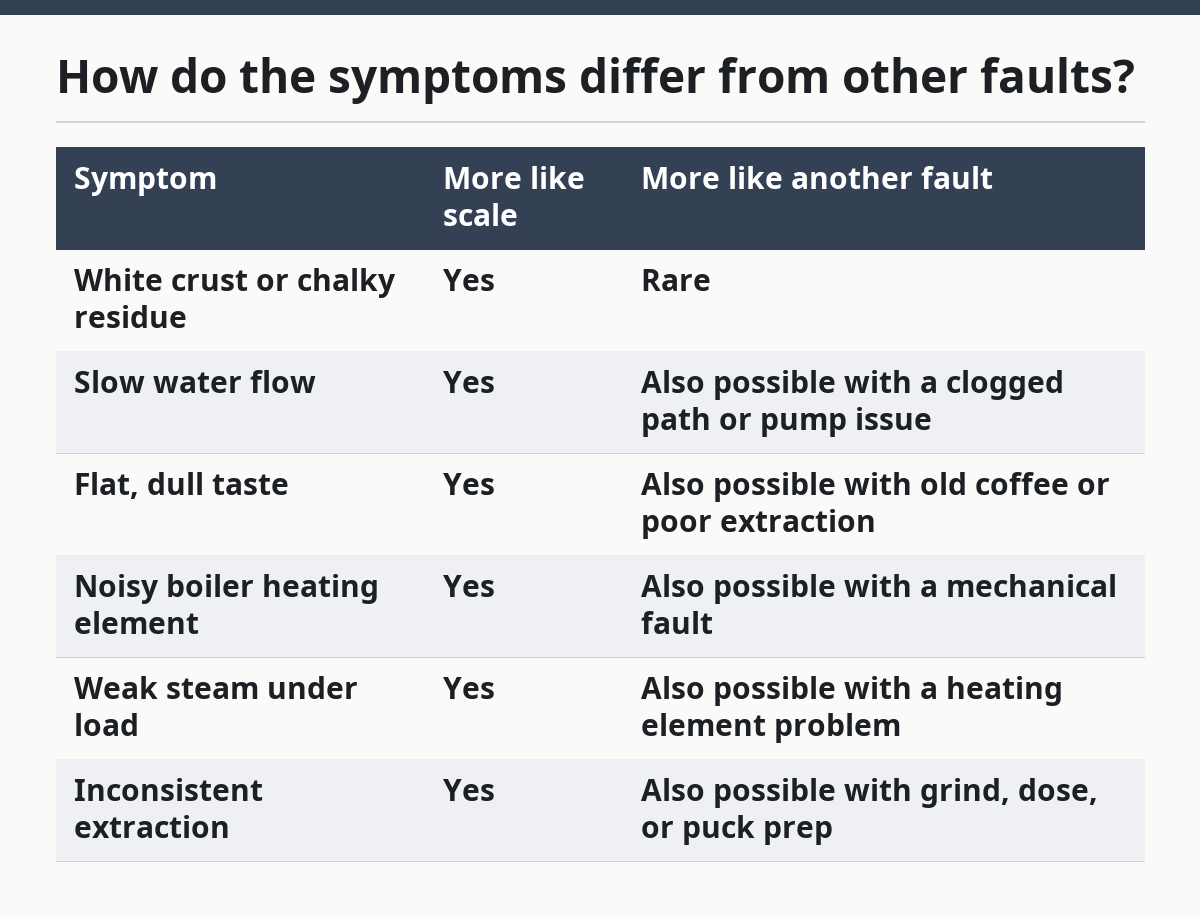
How do the symptoms differ from other faults?

Scale buildup often looks like a cluster of small changes, while other faults usually create one obvious failure. A weak pump, a bad gasket, or stale coffee can hurt espresso quality too, but they do not usually leave white deposits or rust spots behind.
| Symptom | More like scale | More like another fault |
|---|---|---|
| White crust or chalky residue | Yes | Rare |
| Slow water flow | Yes | Also possible with a clogged path or pump issue |
| Flat, dull taste | Yes | Also possible with old coffee or poor extraction |
| Noisy boiler heating element | Yes | Also possible with a mechanical fault |
| Weak steam under load | Yes | Also possible with a heating element problem |
| Inconsistent extraction | Yes | Also possible with grind, dose, or puck prep |
A useful clue is delayed vacuum breaker closure, which can show that pressure behavior is not normal during warm-up. Kettling noises inside the boiler are another useful clue, because they point to boiling and mineral interference around hot surfaces. None of those signs proves scale on its own, but together they make the case stronger.
What should I check on the machine?
The most useful checks are the water path, the boiler area, the steam performance, and the service parts that collect mineral residue. Start with the visible surfaces, then move to the parts that are harder to see, such as the mushroom valve, flow restrictor, and level probe.
- Inspect the outside for white crust and rust spots. Wipe around the steam wand base, group head, fittings, and drip-tray edges. Verify whether the buildup looks chalky and hard, not just like dried coffee. If the residue returns quickly after cleaning, scale is more likely than simple splatter.
- Watch the water flow during a normal shot or flush. Compare the stream to what you usually see. Verify whether the flow seems slow or uneven, because completehomebarista.com lists slow water flow as a common symptom. If the stream hesitates or pulses, the water path may be narrowing.
- Listen for machine noise or squeaking during heating. Pay attention while the boiler warms and while steam is used. Verify whether you hear kettling noises inside the boiler, since that can point to mineral buildup on hot surfaces. If the sound is new or louder than usual, that is a warning sign.
- Check steam strength under load. Open the steam wand during real use, not just a brief test. Verify whether the steam feels weak or drops off as the boiler works, because a partially failed heating element may heat more slowly and may prevent proper steam pressure under load, according to Bay Area Coffee Service. If recovery is sluggish, consider speaking with a qualified appliance professional about your own situation rather than treating it as a minor quirk.
- Look for inconsistent extraction across shots. Pull more than one shot in normal use and compare the results. Verify whether one shot runs differently from the next even when dose and grind stay the same. If the machine behaves inconsistently and the water path also shows deposits, scale becomes a stronger suspect.
- Inspect the mushroom valve. The mushroom valve is the part at the top of many E61-style group heads that helps manage water and pressure flow. Verify whether it has visible mineral buildup or residue after removing and checking it during maintenance. If the valve looks crusted, flow through the group may be affected.
- Check the flow restrictor. This small part limits water flow into the brew circuit. Verify whether it shows narrowing, residue, or uneven flow behavior. If the restrictor is dirty with mineral buildup, slow delivery can show up at the cup.
- Inspect the level probe. The level probe senses water in the boiler. Verify whether the probe has mineral film or crust on it, because scale can interfere with proper reading and boiler behavior. If water level behavior seems strange along with other symptoms, the probe deserves attention.
These checks do not replace a full service, but they help separate scale from a one-off brew problem. The value is in patterns over a few uses, not in a single dramatic symptom.
What should I do before it gets worse?
A simple maintenance rhythm helps catch scale before it becomes a blockage or heating problem. completehomebarista.com recommends descaling every 2–3 months using citric acid or a commercial descaler, and for hard water it also recommends following the manufacturer’s procedure and running cleaning cycles after descaling. For related routine care, see espresso machine maintenance.
Every 6 months, completehomebarista.com also recommends a deeper check: clean the group head, inspect gaskets for corrosion or wear, and consider replacing the water filter. That schedule fits the kind of slow buildup that tends to hide in boilers, valves, and narrow passages. It is not a guarantee against scale, but it gives the machine a regular reset point. See also how to descale an espresso machine.
The practical trade-off is simple. Waiting too long can make symptoms harder to separate from other faults, while overreacting to one odd shot can lead you to chase the wrong problem. The best signal is repeated behavior over time, especially when the same water, coffee, and routine still produce new noise, weaker steam, or slower flow.
When should I stop and call a technician?
You should stop trying to interpret the symptoms yourself when the signs move beyond routine maintenance and into possible hardware trouble. Scale can coexist with other failures, and the wrong assumption can waste time.
Weak steam keeps showing up under load: this may point to a partially failed heating element, not just mineral buildup — a technician should check the element and boiler system.
The boiler heats slowly and recovery gets worse over time: this suggests more than a dirty water path — the machine needs a proper inspection before another cycle of use.
Rust spots or corrosion spread instead of staying local: this can mean moisture and mineral buildup are affecting more than one part — stop and get the system checked.
Kettling noises get louder or happen with other symptoms: this can signal mineral interference inside the boiler — continued use may make the problem harder to separate from other faults.
The vacuum breaker closes late and steam behavior stays odd: this points to pressure behavior that should not be ignored — a technician can check the valve, boiler, and related parts together.
If the symptoms are mild and mostly match the cleaning schedule, routine maintenance may be enough. If the symptoms are mixed, worsening, or paired with electrical trouble, stop treating it as a simple cleaning job and consult a qualified appliance technician.
What mistakes make the problem harder to spot?
The biggest mistake is assuming every bad shot is caused by scale. Flat taste, channelling, and uneven extraction can come from grind or puck prep too, so the clue set matters more than any single cup.
Another mistake is ignoring noise because the machine still works. Kettling sounds inside the boiler and squeaking during operation are not normal background noise, and they often show up before a full blockage. If the machine is still making coffee, that can hide the fact that flow is already changing.
A third mistake is cleaning the outside but never checking the small parts. The mushroom valve, flow restrictor, and level probe are easy to overlook, yet they are exactly where mineral residue can build. Surface cleaning alone can make the machine look better while the internal problem keeps growing.
A fourth mistake is waiting for steam to fail completely. Weak steam under load is already a warning sign, and Bay Area Coffee Service notes that a partially failed heating element can slow heating and prevent proper steam pressure. By the time steam stops feeling useful, the repair path may be longer.
A fifth mistake is skipping the maintenance rhythm after a hard-water stretch. completehomebarista.com recommends descaling every 2–3 months and doing deeper checks every 6 months, because scale builds in layers, not all at once. Missing that rhythm makes the symptoms harder to read later.
Can scale buildup look like something else?
Yes, scale buildup can look like ordinary brewing trouble, which is why the pattern matters. A dull cup can come from old coffee, but dull taste plus white crust and slower flow points more clearly toward mineral buildup.
Weak steam can also be a heating-element problem, and that overlap is why one symptom does not settle the question. In the same way, inconsistent extraction can come from grind size or puck prep, but if the machine also shows rust spots, squeaking, or delayed vacuum breaker closure, scale becomes a stronger explanation.
The cleanest way to think about it is this: scale changes the machine’s behavior over time, while a brewing mistake usually changes the shot from one basket to the next. If the symptoms stay put across several uses, the machine is telling a more durable story.
How do I know if my espresso machine has limescale?
The clearest clue is a cluster of signs, not one symptom by itself. White residue, slower water flow, machine noise or squeaking, flat taste, rust spots, and inconsistent extraction are all common symptoms, according to completehomebarista.com. If those show up together, limescale is a strong possibility.
Can limescale ruin an espresso machine?
Yes, limescale can interfere with flow, steam, and heating, and it can make normal operation harder over time. Weak steam under load, slow heating, and noisy boiler behavior are signs that the machine is under strain, and completehomebarista.com recommends descaling every 2–3 months to keep buildup from getting worse.
Drafted with AI; not yet reviewed by a person.