Last updated: November 19, 2026
Quick answer: 58mm is the better all-around choice for extraction stability and accessory compatibility in this 54mm vs 58mm Portafilter Size: Extraction Differences and Accessory Compatibility comparison. If the goal is the easiest path to broad accessory support and fewer fit surprises, 58mm wins. If the goal is a compact home setup and you already own a 54mm machine, 54mm can still make excellent espresso.
Because of that, the geometry is the first thing to judge: a 54mm basket makes the coffee bed deeper, while a 58mm basket spreads the same style of dose wider and shallower. That difference affects puck depth, accessory fit, and how much room there is for a precision basket, puck screen, and tamper diameter to line up cleanly. For machine examples, see Breville’s 54mm home espresso documentation and La Marzocco’s 58mm portafilter ecosystem.
Key takeaways
- 58mm gives more accessory choice, especially for common tampers, baskets, and puck screens.
- 54mm can be more sensitive to puck prep because the coffee bed is taller for the same dose.
- A taller puck can increase resistance, but it can also make channeling easier to trigger if prep is sloppy.
- 54mm is not “bad”; it is more particular.
- Choose based on your machine, not on a fantasy upgrade path.
What actually changes between 54mm and 58mm?
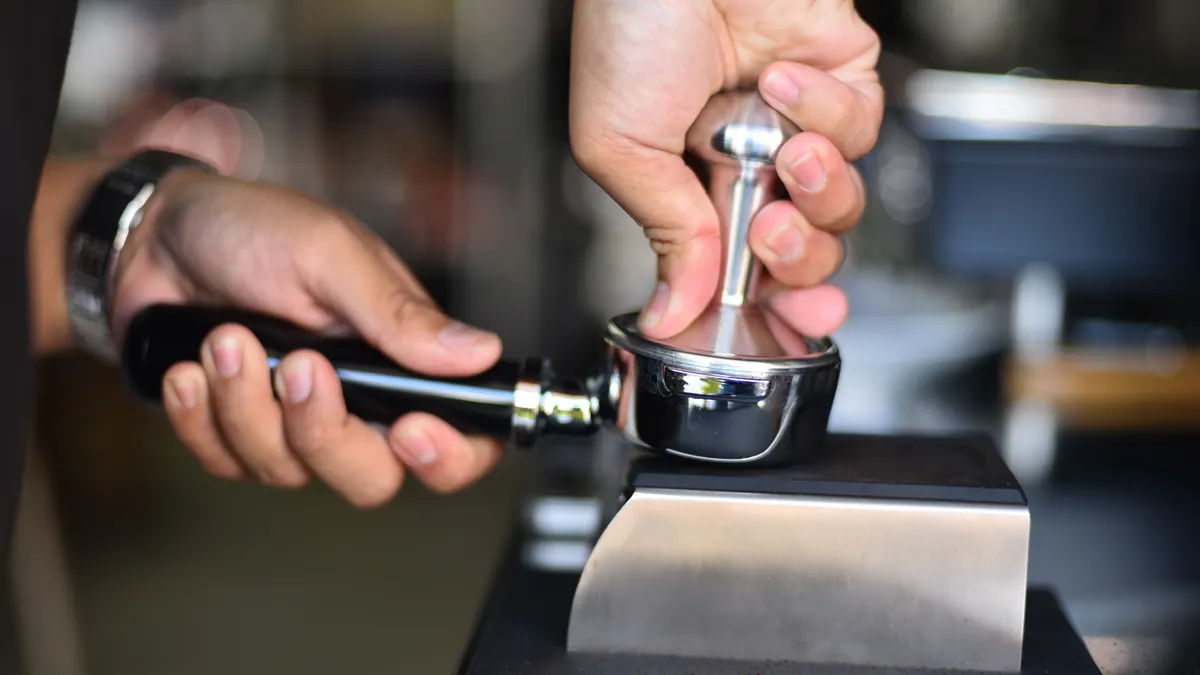
The real difference is puck geometry, not taste by itself. A 54mm basket holds the same style of coffee bed in a narrower circle, so the puck is taller; a 58mm basket spreads that dose wider and shallower. That depth change matters because water has a longer path through the coffee in a 54mm basket, which can raise resistance and make the shot more sensitive to grind, dose, and prep.
Specifically, the smaller diameter does not automatically mean stronger or better. It means the puck behaves differently under pressure, and that behavior can help or hurt extraction depending on the rest of the setup. A compact 54mm system can work well with an E61 group head comparison mindset only in the sense that group design and basket geometry both shape flow; the basket size itself does not tell the full story.
A 58mm basket usually gives the barista more room to even out the bed before tamping. That extra width can make it easier to reduce weak spots. A 54mm basket can still extract beautifully, but the margin for sloppy distribution is narrower because a small defect runs through a deeper bed.
For a reader choosing between them, the question is not “which size tastes better?” It is “which size gives fewer problems with the grinder, the basket, and the tamper already in hand?” That answer is usually 58mm unless the machine is built around 54mm parts.
54mm: who should actually use it?
54mm is the right choice when the machine already uses it and the goal is to keep the setup simple. It fits many home systems well, and it can produce solid espresso with the right grind and dose. The narrower basket can support a compact footprint, which matters more in small kitchens than people admit.
As a result, the drawback is the taller puck. That deeper coffee bed can make extraction more sensitive to uneven distribution, especially if the grinder throws clumps or the tamp lands a little crooked. In practice, that means 54mm can be less forgiving of rushed prep than a 58mm setup. The consequence is familiar: side-channeling, weak spots, or a shot that runs fast on one side and slow on the other.
54mm is for the person who already owns the machine and wants to build around it, not fight it. It is also for the home user who does not plan to collect accessories from every brand under the sun. A precision basket exists in 54mm, and so do tampers and puck screens, but the field is thinner than it is for 58mm.
This size is not for the buyer who expects commercial-style accessory breadth. If the plan is to shop widely for baskets, dosing tools, and tampers with almost no fit anxiety, 54mm can feel restrictive. It is also a weaker choice for someone who changes gear often and wants the broadest aftermarket support without checking every spec twice.
58mm: why it wins for most accessory stacks
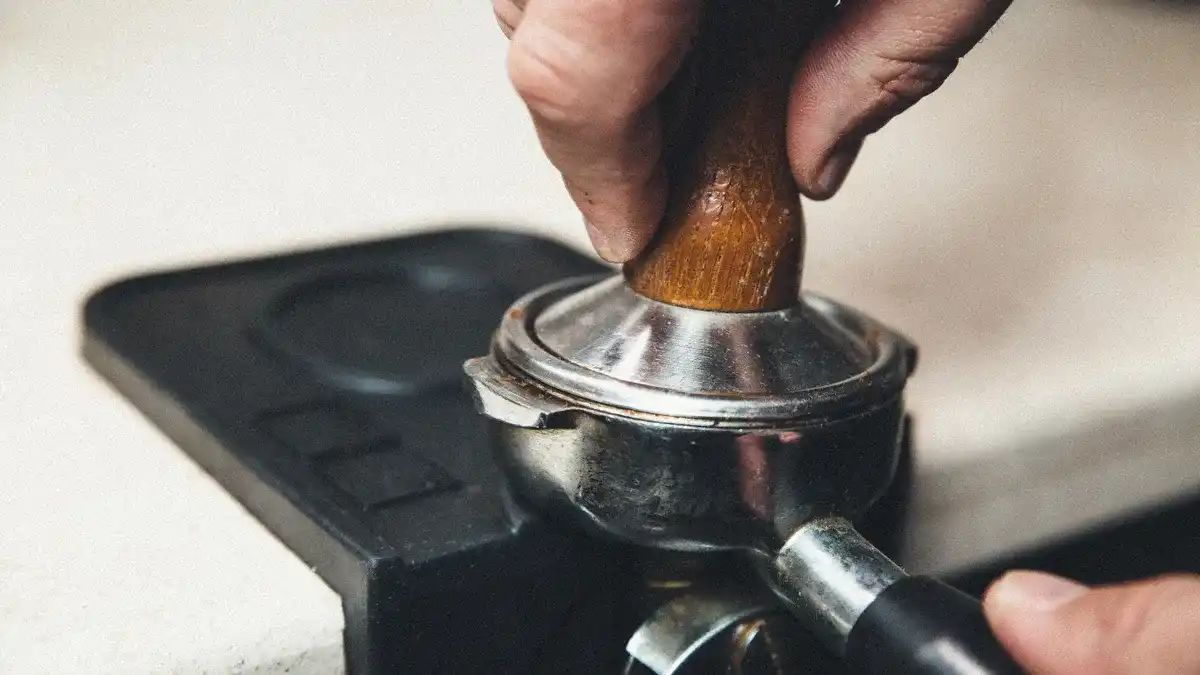
58mm wins for most accessory compatibility because it is the common reference size for a lot of espresso gear. That matters when buying a precision basket, a puck screen, or a tamper diameter that needs to match cleanly without guesswork. A 58mm basket also spreads the dose wider, which lowers puck depth and often makes the bed easier to prep evenly.
Therefore, the main extraction advantage is the shallower bed. With less vertical distance for water to push through, the shot can be a little easier to balance when grind and dose are already close. The wider bed can also reduce the chance that a tiny prep error turns into a deep channel that ruins the shot. The consequence is not magic; it is simply a more forgiving geometry.
The trade-off is size. A 58mm setup can be a better fit for a larger machine, but it may not help if the machine body or workflow is already built around 54mm parts. It can also tempt the buyer into thinking every accessory “just fits,” which is not true. A bottomless portafilter is not the issue here, and this page is not about diagnosing extractions through a naked basket. The real issue is spec matching.
58mm is not for the person who wants the most compact, least expensive path. It is also not the smart pick if the machine only takes 54mm parts; trying to force a larger standard into a smaller system creates more frustration than value.
The honest side-by-side
| Criteria | 54mm | 58mm | Winner for this condition |
|---|---|---|---|
| Puck depth | Taller puck in the basket | Shallower puck in the basket | 58mm for easier flow balance |
| Channeling tendency | More sensitive to prep errors | Often more forgiving | 58mm for inconsistent prep |
| Accessory choice | Smaller field of compatible gear | Broader market support | 58mm for accessory buyers |
| Tamper fit | Must match 54mm exactly | Must match 58mm exactly | Tie when matched correctly |
| Precision basket options | Available, but fewer choices | Widely available | 58mm |
| Puck screen choice | Exists, but fit must be checked | More common and easier to source | 58mm |
| Machine footprint | Often better for compact setups | Usually paired with larger bodies | 54mm for small kitchens |
| Workflow tolerance | Less forgiving of uneven distribution | More forgiving of small mistakes | 58mm |
| Upgrade flexibility | More limited ecosystem | Easier to swap in accessories | 58mm |
| Best use case | Owner of a 54mm machine | Buyer choosing between platforms | 58mm |
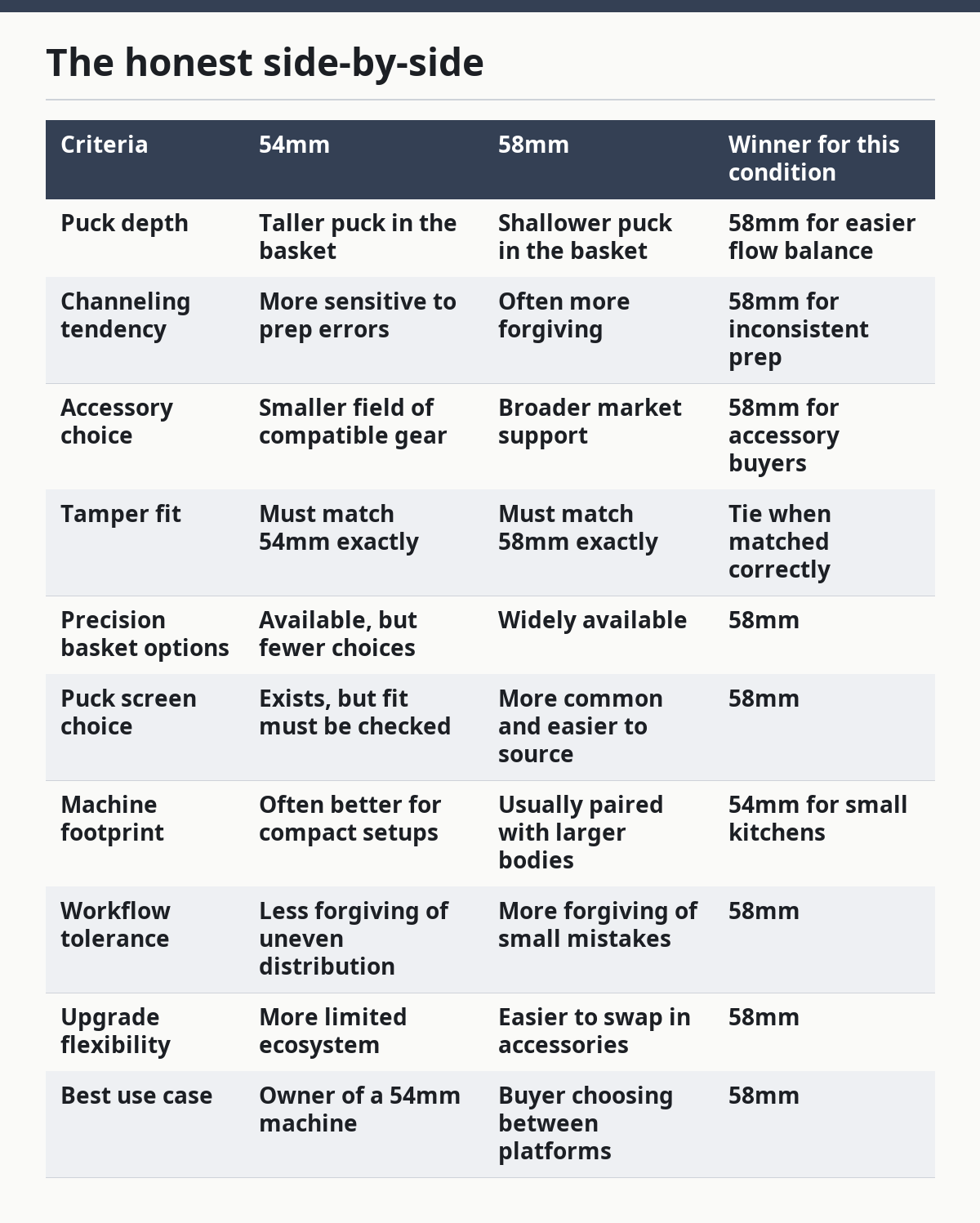
This table is the short answer in practical form: 58mm wins on compatibility and ease, while 54mm wins only when the machine design already calls for it or when space matters more than accessory breadth. The comparison is not about abstract quality; it is about how much room the puck has and how much gear the buyer can source without fit drama.
What does 54mm change in extraction?
54mm changes extraction by making the puck taller and the flow path more constrained. That can raise resistance and make the shot more dependent on even distribution across the full bed. If the coffee is packed unevenly, the water will look for the weak point faster in a deeper puck.
So 54mm does not mean worse extraction; it means cleaner prep. A precision basket helps here because tighter basket work can reduce some of the inconsistency, and a puck screen can help distribute water more evenly at the top of the puck. Those accessories do not erase the geometry, but they can make the geometry easier to live with.
The honest limitation is that a 54mm basket leaves less room for error. If the grinder is already inconsistent, or if the tamp diameter is wrong, the shot can be harder to repeat. That is why 54mm is a fine choice for a committed owner and a poor choice for someone who wants the most forgiving path to espresso.
A 58mm basket does not fix bad prep either, but it usually gives a wider working margin. That is the difference a reader should care about.
When does 54mm beat 58mm?
54mm beats 58mm when the machine is built for it and the buyer values a compact, purpose-matched setup over broad accessory compatibility. If the machine already uses 54mm parts, staying with 54mm avoids adapter-style workarounds and keeps the system clean. That is the practical win.
Likewise, this choice also makes sense when the user is not planning to chase commercial accessories. A home setup that stays within one basket size, one tamper diameter, and one basket style can be perfectly stable. The trouble starts when the buyer wants the same shopping freedom that comes with a 58mm ecosystem, because 54mm simply does not have the same depth of support.
The drawback is obvious: 54mm can be harder to source for odd accessories, and some parts will need more careful checking before purchase. A 54mm user who wants a precision basket or puck screen may find fewer options and more fit questions. That is the price of a smaller standard.
What should most home buyers choose?
58mm is the better choice for most home buyers because it gives the widest accessory compatibility and the easier extraction geometry. It is the safer pick for someone building a setup from scratch, especially if the buyer expects to use a precision basket, a puck screen, and a tamper diameter that is easy to source later.
Choose 54mm if the machine already has it and the buyer is happy to work within that ecosystem. Choose 58mm if the goal is fewer compatibility headaches and a shallower puck that is usually easier to prep evenly. Neither size is a shortcut to good espresso, but 58mm gives the clearer path for most people.
If the reader is mapping a full home setup, this choice also connects to bigger decisions about the machine itself, including the boiler system discussed in the home espresso boiler types hub. Portafilter size is one piece of the same build.
Exception scenarios
There are a few cases where the verdict flips. First, if the machine is already a 54mm model and the buyer is not replacing the whole setup, 54mm is the correct answer by default. Second, if counter space is tight and the user wants the smallest practical accessory stack, 54mm can be the better fit.
Third, if the buyer already owns a full set of 54mm accessories, switching to 58mm just to chase a broader market makes little sense. Fourth, if the machine body or portafilter design is tied to a specific 54mm system, forcing 58mm thinking into it only creates wasted spend and mismatched parts.
The key point is simple: the right size is the one that matches the machine and the workflow, not the one that sounds more “pro.”
Which one should you buy?
Choose 58mm if you are picking a machine or building around the most flexible accessory ecosystem and want the easier extraction geometry. Choose 54mm if your machine already uses it and you value compactness more than catalog breadth. Neither if you are shopping by size alone and ignoring the machine, because the basket diameter has to match the system.
Does portafilter size affect espresso taste?
Yes, but indirectly. Portafilter size changes puck depth and flow behavior, so it can alter how easy it is to get even extraction. A 58mm basket usually gives a shallower bed and a wider working margin, while a 54mm basket can be more sensitive to grind and prep. The cup changes because the geometry changes.
Can you fit 58mm baskets in a 54mm machine?
No, not as a normal fit. A 58mm basket is made for a 58mm system, and a 54mm machine is built around 54mm dimensions. Forcing the larger size into a smaller setup is not a practical upgrade path. If the machine is 54mm, the better move is to choose a good 54mm basket, tamper, and puck screen that match it properly.
Drafted with AI; not yet reviewed by a person.