Last updated: November 18, 2026
Quick answer: for water formulation for espresso machine longevity, aim for a balanced middle, not zero-mineral water and not heavy mineral water. The best water for espresso machine longevity is water that sits in the middle: enough hardness and alkalinity to avoid aggressive, corrosion-prone water, but not so much that it leaves scale behind. The goal in espresso machine water formulation is balance, not purity at any cost or mineral-heavy water at any cost.
Key takeaways
- Hardness and alkalinity do different jobs, so treating them as the same thing leads to bad water choices; if you are unsure how to balance them, consult a water treatment professional or follow your machine maker’s water spec.
- Distilled water is not a safe default for every setup, because it can be too stripped down for metal parts.
- A TDS meter only tells part of the story; it does not tell you whether calcium, magnesium, or alkalinity is where it should be.
- Reverse osmosis water usually needs remineralization before it makes sense for espresso use.
- Potassium bicarbonate can help build alkalinity without adding the same corrosion risks that come with some chloride-heavy mixes.
What water chemistry protects an espresso machine?
Water chemistry protects an espresso machine by controlling scale, corrosion, and heat transfer at the same time. The problem is not just “hard water” or “soft water”; it is the mix of calcium, magnesium, alkalinity, and dissolved salts that passes through the boiler, valves, and brew path.
A lot of generic advice stops at “use filtered water.” That is too vague to help. A more useful rule is this: keep enough minerals in the water to avoid hungry, aggressive water, but keep the water from loading up on scale-forming minerals. In espresso terms, that means balancing Langelier Saturation Index, not chasing a single number on a label.
That balance matters because water carries heat well. According to the U.S. Geological Survey, water has a high specific heat capacity and absorbs a lot of heat before getting hot. In a boiler, that helps with stability, but it also means mineral problems can sit there and cook into deposits over time.
The wrong water shortens life in two different ways. Too much scale coats metal and narrows passages. Water that is too aggressive can push corrosion in the wrong direction, especially in metal boilers and fittings. That is why the question is not “What is the cleanest water?” but “What water keeps the internals healthy for years?”
Hardness vs alkalinity: which one matters more?
Both matter, but hardness and alkalinity do different jobs. Hardness is about the minerals that can form scale, while alkalinity is water’s capacity to buffer acids and resist pH change when acids are added, regardless of its actual pH.
That distinction is where many home users go wrong. A water sample can look “fine” on one measure and still be a bad fit for espresso. If alkalinity is too low, the water can behave more aggressively in contact with metal. If hardness is too high, scale becomes the price you pay.
A useful shorthand is this: hardness is about what can precipitate, and alkalinity is about how the water behaves when conditions change inside a heated boiler. Heat pushes the system around. According to the U.S. Geological Survey, pure water has a neutral pH of 7; below 7 is acidic and above 7 is basic. That does not tell the full story, but it gives the baseline.
Here is the practical split.
| Water choice | Who it is for | What it helps with | What to skip |
|---|---|---|---|
| Distilled water with no remineralization | Almost no one for daily espresso use | Very low mineral load | It can be too stripped down for long-term metal protection |
| Reverse osmosis water with remineralization | Users who want control over hardness and alkalinity | Lets you add back the minerals you actually want | Do not use it plain and assume it is ready |
| Tap water with acceptable balance | People whose water already sits in the right range | Simple, low effort, no mixing | Skip it if it is clearly scale-prone or aggressive |
| Custom bicarbonate-based mix | Users comfortable measuring and adjusting | Fine control over alkalinity | Skip it if you do not want to mix and recheck water |
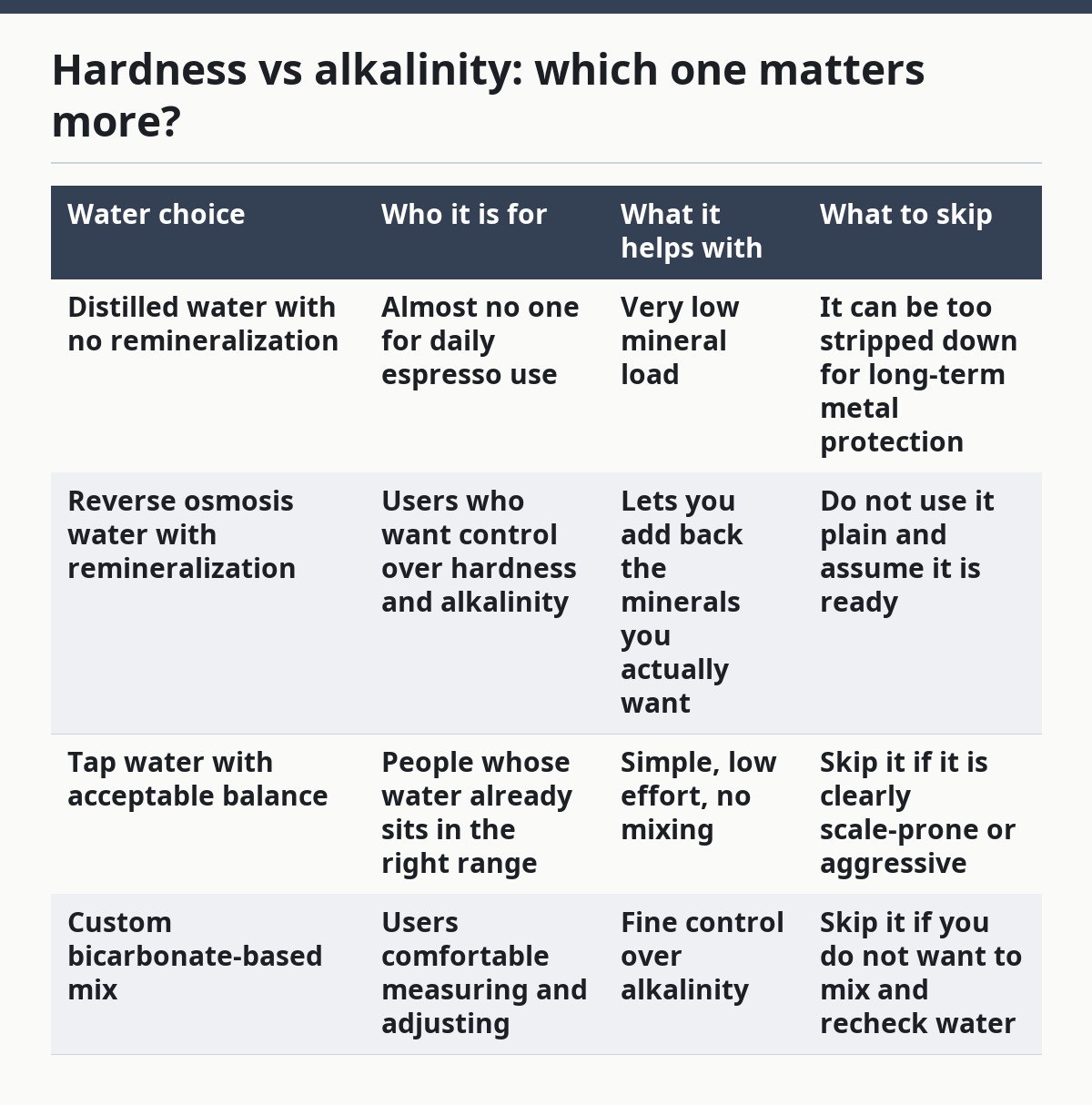
The best choice is not the same for every home. A city with very hard water and high alkalinity needs a different fix than a home with soft, low-alkalinity water. The point is to match the water to the boiler, not to worship a single “pure” option.
Can I use pure distilled water in an espresso machine?
Pure distilled water is usually not the right everyday choice for an espresso machine. It avoids scale, but it can also leave the system too mineral-poor, which is a poor trade when the goal is machine longevity.
That is the part most people miss. Distilled water sounds safe because it has nothing in it, but “nothing in it” is not the same as “ideal for a boiler.” The water still needs some mineral content and buffering so the internals are not constantly exposed to aggressive conditions.
The same idea shows up in another form with reverse osmosis. RO water is useful because it starts clean, but it usually needs remineralization before it becomes a good espresso water. If you skip that step, you may solve scale and create a different problem.
Use distilled water only as a base for a recipe, not as the final answer. If your only options are plain distilled water or questionable tap water, that is not a reason to rush into the distilled bottle. The better move is to build water with the minerals you want, then check that it still behaves like water that can protect a boiler.
How do I build water for espresso without creating scale?
You build espresso water by starting with low-mineral water, then adding back hardness and alkalinity in a controlled way. The practical tools are reverse osmosis water, a TDS meter, and a remineralization approach that uses the minerals you actually want in the boiler.
Follow this process.
- Start with reverse osmosis water or distilled water as your base. The result should be water with very little mineral load, so you are not fighting unknown tap chemistry.
- Add minerals in a controlled way rather than guessing from taste alone. Use a recipe built around calcium sulfate for hardness and potassium bicarbonate for alkalinity if you want to keep the buffer side in play.
- Measure the result with a TDS meter. The number does not tell the whole story, but it gives you a quick check that the water is no longer blank.
- Keep the mix balanced so it is not scale-heavy and not overly aggressive. The target is water that protects metal parts while still avoiding visible deposit buildup.
- Use the same recipe consistently once it works. A stable recipe is better than frequent small changes, because boilers respond to repeatable water more than to experiments.
Calcium sulfate matters because it contributes hardness without turning the water into a random soup of dissolved salts. Potassium bicarbonate matters because it helps set alkalinity, which is the buffer that softens acid swings. Magnesium chloride can be part of water discussions, but chloride-bearing water deserves caution because chloride is linked to pitting risk in metal systems; if you are designing a mix for a machine with a lot of stainless or mixed metals, consult a water treatment professional or the machine manufacturer before using it.
This is the point where the test-kitchen mindset helps. A good formula is not just “more mineral” or “less mineral.” It is like controlling carryover cooking: the setup keeps changing after the heat is on, so the recipe has to account for the effect, not only the starting point.
What is the role of a TDS meter?
A TDS meter is a quick screening tool, not a complete water answer. It tells you that dissolved solids are present, but it does not tell you whether those solids are the right ones for hardness, alkalinity, and corrosion control.
That limitation matters because two waters can show similar TDS and behave very differently in a boiler. One may lean toward scale because of the mineral mix. Another may be less likely to scale but still too aggressive for long-term metal health.
Use the meter as a checkpoint after mixing, not as your only judge. If you are building water from reverse osmosis or distilled water, the meter can confirm that you added something back. It cannot tell you whether you added the right balance of calcium sulfate and potassium bicarbonate.
The same caution applies to buying water based on a single label claim. A number on a bottle or a dispenser is not enough if you are trying to protect a boiler, steam wand, and valves over years of heat cycles. The chemistry has to make sense, not just the reading.
Which mistakes shorten espresso machine life fastest?
The fastest way to shorten life is to chase “purity” or “mineral” without a plan. Both extremes cost money later, either in scale removal, part wear, or avoidable corrosion.
Here are the mistakes that matter most.
First, using pure distilled water as a long-term habit can leave the system too stripped. That costs you in corrosion risk and unstable water behavior, and the fix is to remineralize instead of pouring it straight from the bottle.
Second, using hard tap water because it tastes good can load the boiler with scale. That costs you heat transfer and can narrow passages, which is a bad trade for a piece of equipment that depends on stable flow.
Third, ignoring alkalinity and focusing only on hardness leaves the buffer side unmanaged. That costs you control when the water is heated and acids enter the system through normal use.
Fourth, assuming all minerals are equal can push you toward mixes that include chloride where it does not belong. That costs you because chloride-rich water can be hard on metal boilers and fittings.
This is also where the Zurich example matters. According to Helena Coffee Vietnam, at least 10% of tap water in Zurich has alkalinity above 370 ppm CaCO3. That kind of spread shows why a neighborhood’s tap water can be very different from the next one, even before you touch a filter or recipe.
What water should I choose if I want the longest life?
Choose a balanced water recipe or a tap source that already sits in a sensible middle, and skip the extremes. That is the most practical answer for long machine life, because it reduces both scale risk and corrosion risk.
If your tap water is already moderate and stable, you may only need a simple filter strategy. If your tap water is clearly hard, high in alkalinity, or otherwise inconsistent, reverse osmosis remineralization gives you more control. If your only plan is distilled water in the tank, that is the wrong long-term answer for most setups.
The decision looks like this:
- Use plain tap water only if you know it is already balanced.
- Use reverse osmosis plus remineralization if you want control.
- Use a potassium bicarbonate water recipe when you need better buffering.
- Keep an eye on calcium sulfate if you are building hardness from scratch.
- Treat magnesium chloride with caution in metal-heavy systems and verify any chloride-bearing recipe with a professional or your machine’s documentation.
For a maintenance routine that fits into the rest of the season’s work, pair the water choice with the broader home espresso machine maintenance schedule on this site. Water is one part of longevity, but it is the part that keeps shaping every other cleaning task.
If there is one line to keep, it is this: good espresso water is not the softest water or the hardest water; it is the water that keeps scale low, buffering steady, and metal parts out of trouble.
According to the U.S. Geological Survey, water boils at 212°F at sea level and 202.9°F at 5,000 feet, which is a reminder that water behaves differently with heat and pressure too. In espresso, that means the recipe has to fit the heat environment, not just the glass of water on the counter.
Drafted with AI; not yet reviewed by a person.


One thought on “Water Formulation for Espresso Machine Longevity”