Last updated: November 21, 2026
Quick answer: for most home espresso setups, the rotary pump is the better pick in 3 of the 4 priorities that matter most here—noise, pressure delivery, and plumbed use—while the vibratory pump usually wins on size and cost. Rotary Pump vs Vibratory Pump in Home Espresso Machines: Sound, Lifespan, and Pressure Delivery is really a choice between quieter, steadier brewing and a simpler, cheaper machine. Choose a rotary pump if you want quieter operation, steadier pressure delivery, and a machine built for plumbed use. Choose a vibratory pump if you want a simpler, cheaper setup and do not mind more noise or a less polished pressure ramp-up.
The espresso water pump is one of the few parts that changes how the shot feels before it changes how the shot tastes.
Contents
- Key takeaways
- What is the real difference between these two pumps?
- Why does sound matter so much?
- Which pump lasts longer?
- How does pressure delivery change the shot?
- Who should pick a vibratory pump?
- Who should pick a rotary pump?
- What are the exception cases?
- The verdict: which one should you choose?
- Can you plumb in a vibratory pump espresso machine?
- How long do espresso vibratory pumps last?
Key takeaways
- Rotary pumps usually sound calmer and feel more controlled because they can deliver pressure in a steadier way.
- Vibratory pumps are common in home espresso machines because they are simpler and usually fit smaller, less expensive designs.
- For a plumbed espresso machine, a rotary vane pump from Fluid-o-Tech is the more natural fit.
- An ULKA vibratory pump can still make excellent espresso, but it is the noisier, more stop-start option.
- The right choice depends less on taste alone and more on where the machine lives, how much noise you can tolerate, and whether you want plumbing.
What is the real difference between these two pumps?
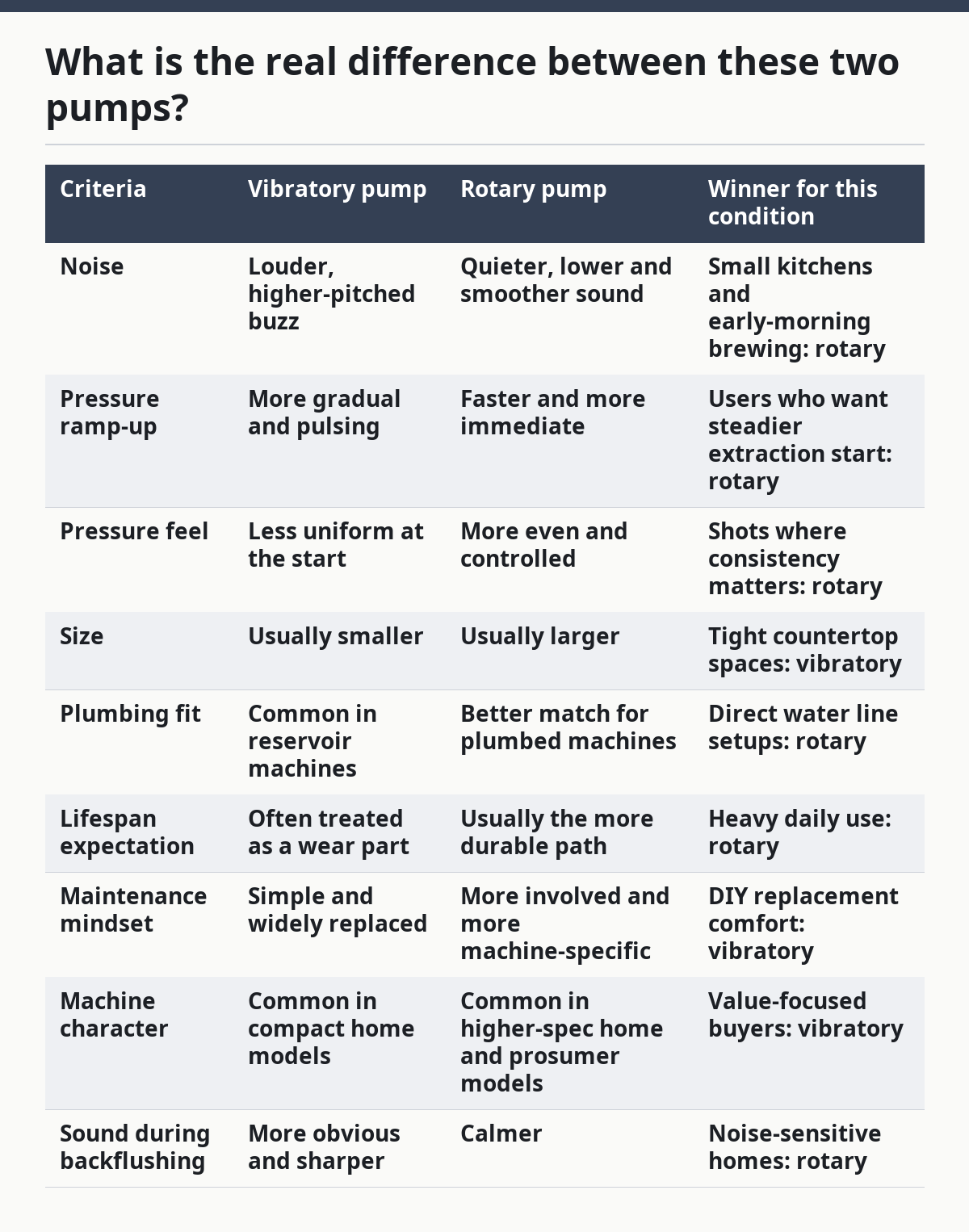
Therefore, the real difference is how each pump builds and holds pressure. A vibratory pump usually sends pressure up in a more gradual, pulsing way, while a rotary pump can reach its target more quickly and hold it with less obvious chatter. That matters most during the first seconds of extraction, when pressure ramp-up shapes the start of the shot.
Specifically, a vibratory pump, often the ULKA type found in many home espresso machines, is compact and common. A rotary vane pump, such as a Fluid-o-Tech unit, is the more industrial-style choice and is often paired with plumbed machines. The expansion valve and accumulator sit in that same pressure system, so the whole path matters, not just the pump itself.
| Criteria | Vibratory pump | Rotary pump | Winner for this condition |
|---|---|---|---|
| Noise | Louder, higher-pitched buzz | Quieter, lower and smoother sound | Small kitchens and early-morning brewing: rotary |
| Pressure ramp-up | More gradual and pulsing | Faster and more immediate | Users who want steadier extraction start: rotary |
| Pressure feel | Less uniform at the start | More even and controlled | Shots where consistency matters: rotary |
| Size | Usually smaller | Usually larger | Tight countertop spaces: vibratory |
| Plumbing fit | Common in reservoir machines | Better match for plumbed machines | Direct water line setups: rotary |
| Lifespan expectation | Often treated as a wear part | Usually the more durable path | Heavy daily use: rotary |
| Maintenance mindset | Simple and widely replaced | More involved and more machine-specific | DIY replacement comfort: vibratory |
| Machine character | Common in compact home models | Common in higher-spec home and prosumer models | Value-focused buyers: vibratory |
| Sound during backflushing | More obvious and sharper | Calmer | Noise-sensitive homes: rotary |
For a broader view of how pump choice fits the rest of the brew path, the pressure section below connects the pump to the heater and pressure system without mixing the topics. For a related read, the hub on home espresso boiler types helps show how heat and pump choice interact.
Why does sound matter so much?
However, sound matters because the pump is the part you hear every day, not just the part you read about on a spec sheet. A vibratory pump usually announces itself with a sharper buzz, while a rotary pump tends to sound lower and less harsh. That difference is one of the most obvious reasons people upgrade.
This is not only about comfort. In a shared home, a loud pump can turn a 6 a.m. shot into a household problem. A rotary pump is the better pick if the machine sits near bedrooms, a phone call, or a sleeping child. A vibratory pump is not broken because it is noisy; it is just less polite.
Here the trade-off is simple. Vibratory pumps fit smaller, simpler machines, and that economy shows up in the sound. Rotary pumps usually cost more in the machine design, and one reason is the quieter, steadier operation. If silence is the goal, the vibratory pump is the one to skip.
For a useful technical reference on pump maker families, Fluid-o-Tech’s rotary vane pump pages are a good starting point, and ULKA’s pump catalog shows how common vibratory designs are in espresso equipment: Fluid-o-Tech and ULKA.
Which pump lasts longer?
So the rotary pump is usually the longer-lasting choice, and that is the main reason it shows up in more serious home and plumbed espresso machines. A rotary vane pump is built for sustained use, while a vibratory pump is often treated as a service part that may need replacement sooner in a busy kitchen; if you are unsure what your machine uses, check the service manual or ask a technician.
That does not mean a vibratory pump is fragile in every case. It means its job is lighter and its design is simpler. For one or two drinks a day, an ULKA vibratory pump can be perfectly sensible. For a household that pulls shot after shot, the rotary pump has the edge because it is the more durable style by design.
The drawback of choosing a rotary pump for lifespan is cost and complexity inside the machine. If the machine is inexpensive, the rest of the build may not be tuned to match the pump’s lifespan, and you may end up paying for durability you do not use. If the machine will be used hard for years, though, the vibratory pump is the one more likely to become a maintenance item first.
How does pressure delivery change the shot?
Because espresso is sensitive to the first seconds of water flow, pressure delivery changes the shot. A vibratory pump tends to bring pressure up more gradually, so the start of extraction can feel less abrupt. A rotary pump can hit target pressure more directly, which gives a more stable foundation for the shot.
That difference is why people talk about “feel” as much as pressure number. A machine with a rotary pump often gives the impression of a firmer, more composed start. A vibratory pump can still make excellent espresso, but the pressure ramp-up is usually less smooth. If your workflow depends on a repeatable start from shot to shot, rotary wins.
Meanwhile, the expansion valve and accumulator matter here because they shape how pressure is handled once the pump starts working. A well-designed system can make either pump behave better. Still, the pump sets the tone. If the machine is built around a vibratory pump, expect more audible effort and a more obvious ramp. If it is built around a rotary pump, expect a calmer, more controlled delivery.
Who should pick a vibratory pump?
Therefore, a vibratory pump wins for the buyer who wants a compact home espresso machine and does not need plumbing. It is the better fit for a kitchen where space, price, and simplicity matter more than near-silent operation. Many home users are best served by this option because it keeps the machine smaller and easier to place.
The real strengths are practical. Vibratory pumps are common, familiar, and generally easier to accommodate inside a home machine. They also fit the kind of buyer who makes a few drinks a day and wants good espresso without paying for a rotary system that the household may never fully use. An ULKA pump is a normal, proven choice in that lane.
However, the weaknesses are just as practical. The sound is more noticeable, the pressure rise is less polished, and lifespan expectations are usually lower than with a rotary vane pump. This is not the pump for a quiet apartment, a heavily used household, or anyone who wants the machine to feel closer to plumbed café gear. If the noise bothers you now, it will bother you later.
In particular, the lifespan section below is the place to compare replacement expectations before buying.
Pros and cons of a vibratory pump
| Pros | Cons |
|---|---|
| Compact fit in smaller machines | Louder buzz during use |
| Common in home espresso machines | Less refined pressure ramp-up |
| Usually a simpler design | More likely to be treated as a wear part |
| Good match for occasional home use | Not the best choice for direct plumbing |
For a related overview of machine sizing, see the espresso machine size guide.
Who should pick a rotary pump?
On the other hand, a rotary pump wins for the buyer who wants quieter brewing, better pressure control, and a machine that makes sense on a water line. This is the better choice for a plumbed espresso machine and for users who make several drinks a day without wanting the sound of a busy appliance in the room.
The strength of a rotary vane pump, such as a Fluid-o-Tech unit, is not mystery or hype. It is mechanical control. The pressure delivery is calmer, the noise is lower, and the machine usually feels more substantial because the pump itself is built for that kind of duty. For a buyer who notices the first second of a shot, that matters.
So, the weakness is obvious: it is usually the more expensive and less compact route. Rotary pumps also make less sense if the machine will never be plumbed and the user only wants a simple weekend setup. If you do not care about plumbing, noise, or a more industrial feel, the rotary pump may be more machine than you need.
Next, the comparison with plumbing is important enough to warrant a direct answer.
Pros and cons of a rotary pump
| Pros | Cons |
|---|---|
| Quieter operation | Usually bigger and more complex |
| Better match for plumbed machines | Often found in pricier designs |
| Steadier pressure delivery | Less necessary for casual use |
| Stronger fit for heavy daily brewing | Can be overkill in a small kitchen |
What are the exception cases?
Ultimately, the verdict flips in a few clear cases, and ignoring them leads to the wrong purchase. If the machine will live in a studio apartment, a vibratory pump may be the better compromise because size and cost matter more than perfect sound control. If the machine is not going to be plumbed, the rotary advantage loses some weight.
Another flip happens if the buyer replaces machines often. In that case, lifespan matters less than entry cost, and a vibratory pump makes more sense. A third exception is a kitchen where the espresso corner is far from sleeping space; the rotary pump’s noise advantage becomes less valuable. The last exception is a buyer who enjoys a lighter, simpler machine and does not want the bulk of a more serious pump system.
One thing does not change: if the buyer wants the most composed pressure delivery and the least noise, the rotary pump still wins. The exception cases only shift the value of that win.
The verdict: which one should you choose?
In short, choose a rotary pump if you want a quieter machine, steadier pressure delivery, or a plumbed espresso setup. Choose a vibratory pump if you want a simpler home machine, smaller footprint, and lower complexity, and you can live with more noise. Neither if you want silent operation, because this is still a pump-driven espresso system and the sound will never disappear.
Can you plumb in a vibratory pump espresso machine?
Usually no, not as the better choice. A vibratory pump is more commonly used in reservoir-fed home espresso machines, while a rotary pump is the natural fit for direct plumbing. Some machines can be adapted, but the pump design and the rest of the water path are not built around the same use case, so the match is poor.
Therefore, if plumbing is a must-have, it is better to start with a rotary pump machine than to retrofit a vibratory one.
How long do espresso vibratory pumps last?
There is no single lifespan figure that fits every ULKA-style vibratory pump, because use, water quality, and machine design all matter. In general, a vibratory pump is treated as a more replaceable part than a rotary vane pump, especially in machines that see daily use; if long service life is the priority, the rotary pump is the safer pick.
However, service life is not just about the pump type. A well-maintained machine, clean water, and reasonable daily workload can all stretch the useful life of either design. If you want the most exact answer for your machine, consult the manufacturer’s service literature or a qualified technician.
Drafted with AI; not yet reviewed by a person.







2 thoughts on “Rotary Pump vs Vibratory Pump in Home Espresso Machines”